
Items filtered by date: Tuesday, 16 December 2025
Wednesday, 30 November 2016 08:09
Making headway

There have been some well-earned promotions and new appointments at WearCheck recently. Here, we introduce you to the new folk in their new positions…
Our man in the Middle East (image 3)
Peter Safadi recently joined the WearCheck family as the regional manager: Middle East, based at WearCheck PM in Dubai. Peter has spent over 40 years running businesses in the Middle East, including Jeddah, Riyadh, Oman, Bahrain, Egypt, Spain, Morocco and even Iraq. His main focus to date has been on electronics and hydraulics and managing a steel factory. He recently travelled to South Africa to meet the team at WearCheck head office.
Our foreign figure watcher (image 1)
Brandon Bisunath is in the hotseat as one of WearCheck’s two foreign operations book-keepers, where he handles the accounts for the company’s cross-border operations in Zambia, Mozambique and Ghana. Armed with a B.Comm degree from UKZN, and work experience in a shipping company (accounts and finance) and an oil company (logistics), Brandon keeps track of WearCheck’s foreign currency accounting.
Our lady in sales (image 4)
Juliané de Beer has already been part of the WearCheck team for two years, and recently moved across into the sales development arena from customer support. Juliané, who holds a certificate in Business Management, travels many kilometres every day to visit existing customers as well as potential new ones.
Our Steelpoort team (image 2 & 5)
Thomas Madlala has been promoted to business development and technical support at WearCheck Steelpoort.
Josephine Rakolota has been appointed as sales and customer support at WearCheck Steelpoort, with an in depth knowledge of WearCheck’s customers, having provided customer support for 17 years for the company.
Our Witbank worker (image 6)
Dennis Swanepoel has been promoted to branch co-ordinator for WearCheck Witbank, having worked with the company for fourteen years as an analyst and a site manager.
Published in
Blog
Tuesday, 22 November 2016 12:32
Customer dialogue improves service

Based on WearCheck's annual interaction with customers regarding many aspects of service, the company alters the way things are done to improve customer service, and implements new suggestions made by customers.
'A hearty thank you to all customers who took the time to give us feedback, we are happy to receive both compliments and constructive criticism as a means to offer the best possible service to our customers', says WearCheck sales developer Kay Meyrick.
Survey respondents had these kind things to say, for which we are grateful:
- We are very satisfied with the levels of service received
- Carry on with good service
- For the last 12 years I have had no complaints from my own customers.
- They are very happy with the way we do our reports and lube analysis reports
- Excellent service from staff
- Excellent technical support and advice given by Leon Marshall
- Keep up the good work
- Very happy with the service received
- I am thankful for the service of WearCheck
- Happy and entirely satisfied
- Very good and helpful
To thank WearCheck customers for taking the time to respond to the annual survey, a prize is randomly awarded to one lucky respondent. The 2016 winner is Alain Garbaccio from De Beers.
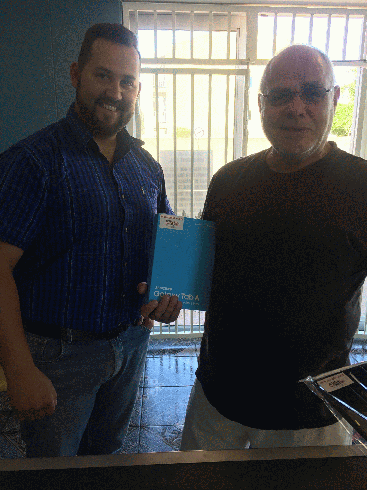
2016 WearCheck customer survey lucky draw winner, Alain Garbaccio of De Beers, (right), receives his prize - a Samsung tablet valued at R6000 - from WearCheck Cape Town branch co-ordinator Quintin Ras.
Published in
Blog
Tuesday, 01 November 2016 11:47
Windaba 2016

Windaba 2016 will soon be blowing into Cape Town, and WearCheck will be there once again.
This year, our popular wind turbine oil analysis kit will be on show – we are experiencing unprecedented demand for this service due to the burgeoning number of new wind farms in Southern Africa.
We invite you to come and “shoot the breeze” with WearCheck at Windaba 2016, 2 – 4 November, Cape Town ICC, stand 53.
On hand to field technical questions, you will find diagnosticians Quintin Ras and Steven Lumley, and reliability solutions manager Philip Schutte.
Published in
Blog
Wednesday, 26 October 2016 14:46
WearCheck gives a helping hand

WearCheck has supported Saint Giles - the non-profit organisation in Durban that assists people with physical disability - for 39 years (nearly as long as the company’s 40 year existence!). The people of Saint Giles pack the WearCheck kits, work for which they are paid by the company.
WearCheck MD Neil Robinson is proud of the company’s long association with St Giles. ‘It is an honour for us to team up with such a caring organisation that helps those in need. And the WearCheck kits are always very neatly packed, so the partnership also helps us!’
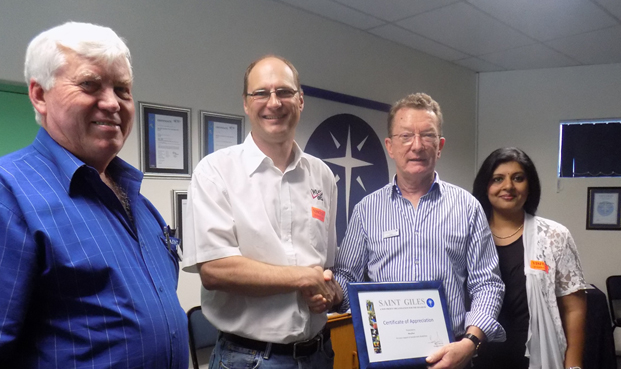
At a recent ceremony, Terry Rennie, managing director of Saint Giles (centre), presented a certificate of thanks to WearCheck for the ongoing support. Receiving the certificate is Neil Robinson, and looking on is Charmaine Thumbiran of WearCheck.
Published in
Blog
Wednesday, 05 October 2016 13:06
WearCheck family now includes Zim
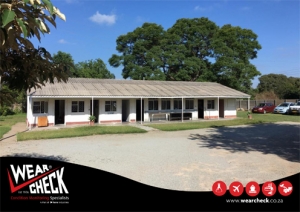
Zimbabwean mining and industrial operations now have their very own local WearCheck laboratory, right on their doorstep!
WearCheck, recently acquired the long-established oil analysis laboratory in the form of Harare-based Tribology Services, and brought it into the WearCheck fold.
The Zimbabwean laboratory has been operating for 27 years, and already services a wide range of clients.
The WearCheck way is to help customers save money and time via a convenient “one-stop-shop” offering the full spectrum of reliability solutions to getting plant to perform at its peak. As well as traditional oil analysis, WearCheck Zimbabwe also conducts thermography, vibration analysis, balancing, laser alignment, motor current analysis and milling.
WearCheck managing director Neil Robinson is pleased with the company’s expansion. ‘We are delighted to welcome all existing and new customers to use WearCheck Zimbabwe’s services. The transition - smooth to date - benefits customers by giving access to the full range of WearCheck services. Our laboratory instruments are constantly upgraded to remain at the forefront of international standards, and our staff members attend ongoing training courses to keep ahead of global condition monitoring trends.’
‘All original staff members at the laboratory have remained, and have undergone WearCheck training. We are currently equipping the laboratory with extra analytical instruments to align the test profiles with other WearCheck laboratories – next on the list for Zimbabwe is a new viscometer.’
WearCheck Zimbabwe offers on-site sampling, as well as a 24-hour sample turnaround. Contact WearCheck Zimbabwe at 23 Amby Drive, Msasa, Harare, or via telephone on +263 4 446-369/71 or cell +263 712 631-026, or email This email address is being protected from spambots. You need JavaScript enabled to view it.
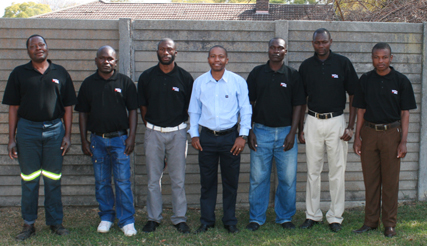
WearCheck Zimbabwe was recently been taken over by WearCheck. Some of the lab technicians took a break for a photograph – they are, from left Nikanori Chikati, Talkmore Siyengi, Admire Katanda, Frank Chakonda (Lab Manager), Rangarirai Mlambo, Emanuel Mhari and Victory Dumbura.
Published in
Blog
Wednesday, 28 September 2016 10:35
WearCheck delivers Husab lab

Namibia’s Husab Uranium Project – a mining operation that is owned by Swakop Uranium – awarded WearCheck a 5-year contract to supply and operate an on-site laboratory, which opened recently.
The on-site laboratory boasts a full complement of instruments, and provides Husab with services such as oil analysis and a wide spectrum of reliability solutions services.
As an open-pit mining operation, Husab uses the conventional truck and shovel mining method. The on-site laboratory is well-placed to maintain the plant used in this process - including a huge scale of loading and hauling equipment - at optimum output capacity.
The laboratory was set up as part of a joint venture with sister company, Set Point Laboratories, who built and supplied the assay side of the laboratory.
Husab Mine is situated 45km from Walvis Bay, and when it reaches full production capacity of around 7 000 t of uranium, it will be the second largest uranium mine globally.
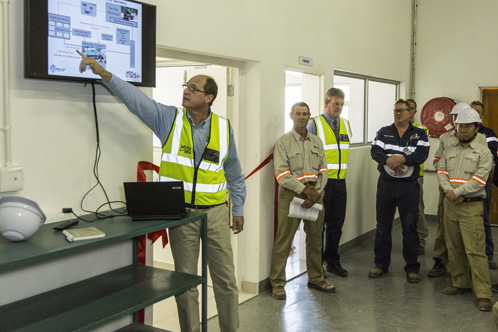
WearCheck managing director Neil Robinson attended the official opening of Husab’s oil analysis laboratory in Namibia. Here, he outlines how the on-site laboratory will boost plant performance.
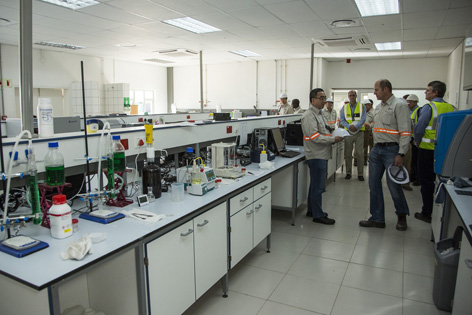
The brand new oil analysis laboratory at Husab, Swakop Uranium, is kitted out with the full complement of laboratory instruments.
Published in
Blog
Monday, 26 September 2016 12:27
International WearCheck Group meets again

This year, China was the destination for the annual International WearCheck Group (IWCG) meeting. Each year, member countries meet in a different part of the world to hear industry news from fellow industry leaders, to learn about the latest technological advancements in condition monitoring and to maintain invaluable dialogue with other IWCG members.

Caption: Spotted in China in July at the IWCG meeting are members of the International WearCheck Group (IWCG), from all corners of the globe, including South Africa, Hungary, China, Spain, Canada and England. WearCheck MD Neil Robinson is standing seventh from the left.
Published in
Blog
Wednesday, 29 June 2016 10:09
How Does Oil Work? Part Two...
How does oil work? Part two.
By John S. Evans, B.Sc
Boundary lubrication
Three parameters need to be considered when looking at the various lubrication regimes. They are: the load placed on the surfaces, the speed at which they are moving relative to each other, and the viscosity of the lubricant. Viscosity is a very important property of a lubricant and will be defined at this point as a fluid's resistance to flow at a particular temperature. Fluids that have high viscosities do not flow easily (such as molasses) - high viscosity oils are sometimes referred to as 'thick' oils. Fluids with low viscosities flow easily (such as water) - low viscosity oils are sometimes referred to as 'thin' oils.
It is important to remember that when an oil is heated up, its viscosity will decrease. In other words, it will 'thin out'. Likewise the viscosity will increase as the temperature decreases and the oil will 'thicken up'. Because of this an oil's viscosity must always be accompanied by the temperature at which the measurement was made for it to mean anything.
In a situation for ideal lubrication the viscosity and the speed should be high and the load low. If this were always the case then lubricated surfaces would always be separated and only fluid friction would come into play. Unfortunately we do not live in an ideal world and this is not always possible.
In the case of a plain bearing and a journal there will be a small amount of lubricant between the mating surfaces. However, because of the load and zero speed on start-up, the lubricant film will not completely separate the bearing from the journal. In this situation the asperities will break through the lubricant film and make contact; this is known as boundary lubrication. All is not lost, however, and the situation is far better than if no oil were present at all. Typically, the coefficient of friction of unlubricated metal surfaces ranges between 1.5 and 0.5. With boundary lubrication it is between 0.1 and 0.02.
Boundary lubrication can be subdivided into: oily lubrication, antiwear lubrication and EP (extreme pressure) lubrication.
1. Oily lubrication takes place through two distinct mechanisms:
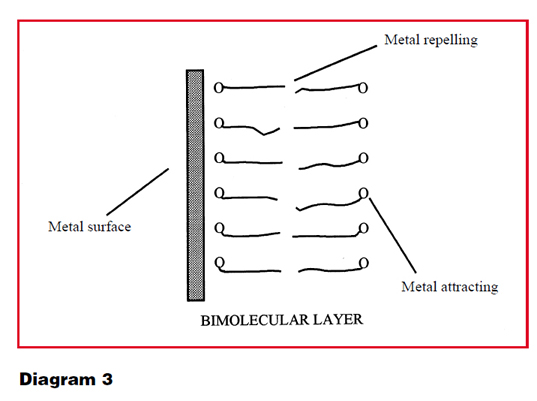
Physical adsorption, whereby oil molecules and compounds blended into the oil are attracted electrostatically to metal surfaces and form bimolecular layers due to the polar nature of these compounds.
A chemical reaction also takes place causing certain compounds in the oil to attach themselves chemically to the metal surfaces. This allows very thin films, usually only one or two molecules thick, to form and help reduce friction whilst not totally separating the metal surfaces (see Diagram 3).
2. Antiwear lubrication occurs because of the presence of chemical compounds in the oil that are specifically designed to react with metal surfaces and form a protective layer. The melting point of these compounds is fairly low and is below the temperature at which EP compounds are effective. Antiwear additives are sometimes referred to as mild EP additives.
3. EP lubrication is required where high pressures and hence high temperatures are encountered. This is achieved by the addition of compounds that contain phosphor which has a high melting point and low shear strength. In other words, they they make the metal surfaces slippery.
Mixed film lubrication
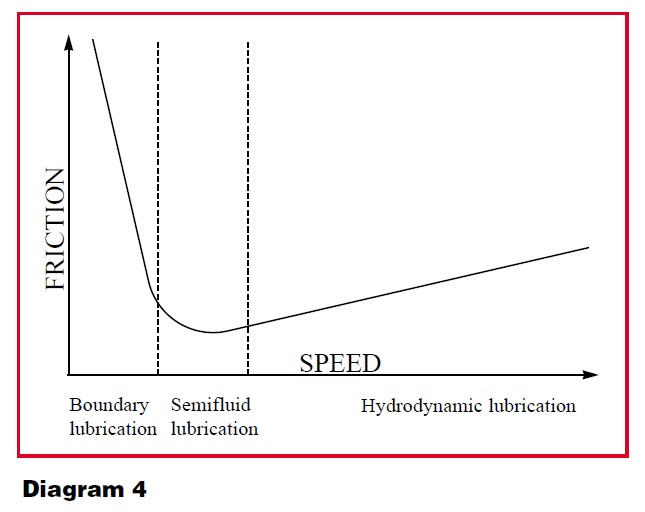
The coefficient of friction in a plain bearing is related to the load on the bearing, the speed at which it is turning and the viscosity of the oil that is lubricating the system. Assuming the viscosity remains constant throughout (as will the load) then the coefficient of friction will vary with the change in speed. On start-up the speed is low (zero) so that the coefficient of friction will be high but will decrease as the speed increases. The graph below illustrates the relationship where initially the solid friction is very high but is gradually replaced with fluid friction as the journal begins to turn.
Mixed film lubrication occurs when boundary lubrication is reduced but the mating surfaces are not quite separated and are supported by a full film of lubricant
(see Diagram 4).
Hydrodynamic lubrication
In theory the journal should be located coaxially with the bearing. However, in practice, this does not happen unless the load is extremely small or the shaft is mounted vertically. In practical cases there is an appreciable load on the oil film and the journal cannot rotate coaxially to the bearing. As speed increases a wedge is formed between the converging surfaces through which the oil is forced as it is entrained by the rotating shaft. At this point the fluid has a greater velocity, and hydrodynamic ressure is created which counterbalances the load and keeps the mating surfaces apart.
Under this type of lubrication regime the coefficient of friction is reduced to the order of 0.005. It will be noted from the graph that the minimum friction is achieved just before the onset of hydrodynamic lubrication. It is at this point that solid or static friction is replaced by fluid or kinematic friction. Unlike solid friction, fluid friction is dependant on speed and gradually increases as the speed increases.
Elastohydrodynamic lubrication (EHD)
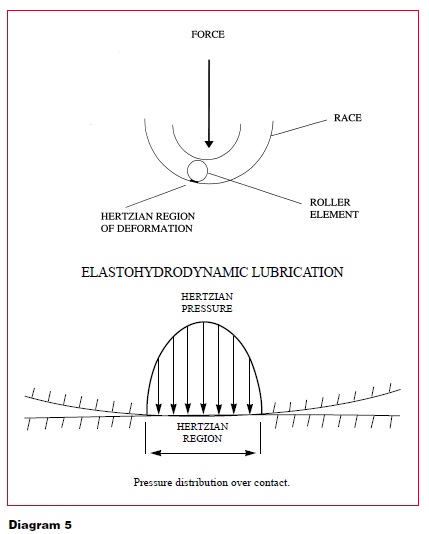
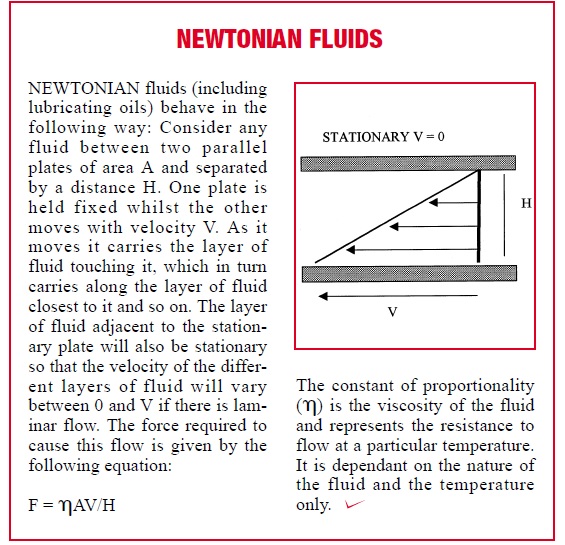
The surfaces in relative motion that require lubrication that have been considered so far have had the same geometry, that is they fit together like two spoons. In the case of a ball or roller bearing, the contact area between the mating surfaces is vanishingly small. With a ball bearing in a race, the area of contact is a tangential point and, with a roller bearing, a tangential line. Remember that pressure is defined as force over area and this situation the area is very small. With normal loads in roller elements, pressures of 1.5 Gpa (1,5 million kilopascals) can be reached. Under these conditions both the roller elements and the oil behave in a non-Newtonian fashion (see Newtonian fluids section on back page). These high pressures are known as Hertzian pressures and the point or line of contact of the roller is known as the Hertzian region. These high pressures cause both the roller and the race to elastically deform to a small degree which spreads the pressure over a small but finite area. Oil is drawn into the Hertzian region by hydrodynamic forces and when subjected to these Hertzian ressures the viscosity increases (reversibly) dramatically and has the consistency of window putty. It is this increase in viscosity that enables the oil to lubricate under these extreme conditions and this lubrication regime is known as elastohydrodynamic lubrication.
John Evans is the Diagnostic Manager WearCheck Africa. Copies of previous Technical Bulletins can be accessed on Wearcheck's website: www.wearcheck.co.za. Readers who would prefer to receive future issues of Wearcheck Technical Bulletin and Monitor via e-mail, please e-mail a request to: This email address is being protected from spambots. You need JavaScript enabled to view it.
Published in
Blog
Wednesday, 29 June 2016 09:18
How Does Oil Work? Part One...
How does oil work? Part One.
By John S. Evans, B.Sc
Friction is a ubiquitous part of our daily lives. Walking, writing, opening doors and drawers and driving to work all involve energy being expended in order to overcome friction.
Although friction is generally thought of as a negative mechanical characteristic (approximately 20% of a car's energy is spent in overcoming friction) it must be remembered that without it we would not be able to walk and the brakes on our cars would not work.
Friction is usually seen as a mechanical problem and the force necessary to overcome it has long interested engineers. When man invented the wheel it enabled him to move weights around with far less expenditure of energy than if they were dragged from A to B. What he had in fact done was to replace sliding friction with rolling friction which has a much lower value.
This blog looks at the role of oil in reducing the harmful forces of friction.
Friction
An understanding of friction will be helpful as a starting point. Friction can be defined as the resistance encountered when one body moves relative to another body with which it is in contact.
The laws and coefficient of friction
The basic laws of friction were 'sensed' by Leonardo da Vinci but were not studied scientifically until the 18th century by Coulomb and Amontons, which led to the definition of three laws:
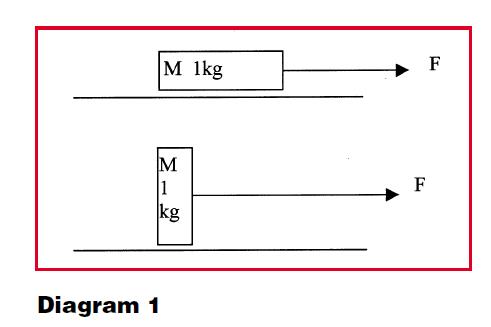
The first law states that the force of friction that exists between two surfaces is directly proportional to the perpendicular pressure between them. In order to slide a metal cube of mass M across a table, a tangential force, F, must be applied. If M is doubled then F must also be doubled to get M to move.
The second law states that the force of friction is independent of the surface area of M in contact with the surface over which it is being made to slide. If M were to have an oblong cross section, it would not matter whether the larger or smaller surface area was placed on the table; the force of friction, or the force required to move both blocks, would remain the same. Diagram 1 illustrates this point.
The third law says that the force of friction is dependent on the nature and state of the surfaces.
Smooth surfaces generate less friction than rough surfaces. The first law can be restated as the ratio between F and M for a particular system is constant and F/M is known as the coefficient of friction. This coefficient can be easily measured by using gravity to make a metal block slide across a surface. Although the mass can be weighed and the force to get it to move easily determined, inertia causes problems.
Newton's first law of motion can be interpreted as saying that bodies at rest tend to stay that way unless acted upon. This means that the initial energy required to get the metal block to start moving (overcome static friction) is higher than the energy required to keep it moving (overcome dynamic riction). Once the initial energy has been expended to overcome the static friction, the coefficient of friction settles down to a constant value equal to the dynamic friction. Thus frictional drag is lower once a body is in motion.
Causes of friction
Surfaces that appear smooth and shiny to the naked eye will show peaks and furrows when examined with a microscope or even a magnifying glass. This does not mean that the component has been poorly machined but that components manufactured to prescribed tolerances may still have fairly rough surfaces at microscopic level (see Diagram 2).
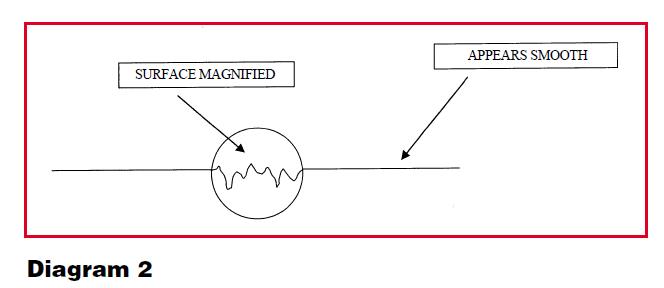
When two surfaces are brought into contact, it is the tips of the peaks that actually touch, meaning that large areas of the surfaces never come into contact. For example, the contact area of two flat steel surfaces subjected to a pressure of 0.5 kgcm-2 is about 1/40 000th of the apparent surface area. The size of the contact area not only depends on the surface area and roughness but also on the load acting on the two surfaces. The peaks where contact actually takes place are called asperities.
Because it is the asperities that touch and because they make up a very small surface area, very high pressures and temperatures are achieved which can cause metal deformation and cold welding to take place. When the surfaces slide over each other, microscopic welds are produced between peaks which, due to the relative motion, are then torn apart. The laws of friction apply to one clean metal surface sliding over another. The laws break down when thin metal films or oxidised surfaces are considered. They also do not apply to very hard surfaces (eg. a diamond) or very elastic surfaces (eg. rubber) where the contact area no longer depends on pressure.
Friction and wear
Whenever friction is overcome, the dislocation of surface material generates heat and this frictional heat can be highly destructive to metal surfaces and cause wear to take place.
Additionally, when there is solid friction (as opposed to fluid friction) wear will also take place. Material is lost due to the cutting action of opposing asperities and to the shearing of microscopic welds. In extreme cases the combination of high frictional temperatures, welding and shearing can cause complete seizure of moving parts.
The harmful effects of friction cannot be overemphasised. The job of the engineer and particularly the lubrication engineer is to control friction: to increase it where it is needed and to decrease it where it will cause damage. Lubrication reduces friction by replacing solid friction with fluid friction.
Sliding and rolling friction
When one body slides over another, the force of resistance encountered at the points of contact is known as sliding friction. If a ball or cylinder were to roll over a metal surface, the relative velocity of the points of contact are actually zero and this results in rolling friction. It should, however, be noted that rolling friction is always accompanied by some sliding friction.
Two main types of rolling friction exist. The first is where large tangential forces are experienced as in the case of a car wheel in contact with the road which generates considerable sliding forces. The second is where minimal tangential forces are present as is the case with a ball or roller bearing. This is sometimes known as free rolling.
Studies show that elastic deformation of the roller and the surface occurs and this gives rise to the resistance to motion (friction) that is encountered. The energy returned to the system when the deformation returns to normal is less than the energy required to cause the deformation. This excess energy is lost as frictional heat. Tests show that rolling friction is not influenced by the presence or absence of a lubricant. However, lubrication is still important in this situation because the elastic deformation of the surfaces introduces sliding friction which can be reduced by the introduction of a lubricant to convert solid friction into fluid friction.
Lubrication
The friction that exists between two bodies in relative motion involves an appreciable energy loss which needs to be minimised. This is achieved by feeding lubricants between these sliding surfaces which replace solid friction with fluid friction which can be far smaller. A lubricant must possess two basic properties: some degree of fluidity to spread over the surfaces and adhesive power to allow the fluid to remain in place during motion. Oils are particularly well suited to this job.
When an oil is fed in between two moving surfaces it causes them to separate and in doing so eliminates the solid friction that exists between them. Unfortunately viscous drag (fluid friction) exists in the oil so that friction can never be totally eliminated but it can be greatly reduced. The oil can cause the surfaces to separate in a number of ways and, when this is not completely possible, friction is still kept to a manageable level.
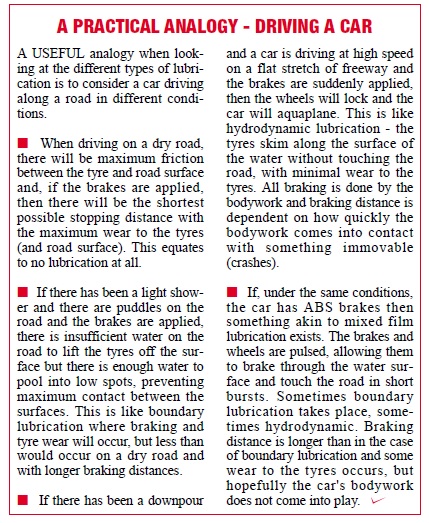
The lubrication regimes that will be considered here are: boundary lubrication, mixed film lubrication and hydrodynamic lubrication which includes elastohydrodynamic lubrication (EHD).
More to follow in part two, alternatively click here to download the pdf.
Published in
Blog
Thursday, 23 June 2016 08:10
Translated Technical Bulletins

Bonjour! Bom dia!
Did you know that some of our most popular Technical Bulletin titles are now available online in French and in Portuguese?
The documents are on the WearCheck website, and can be downloaded as pdf files, for FREE!
Newly-translated Technical Bulletin titles are uploaded regularly, so make sure you keep checking to get them all.
Please click on the icon of the French or Portuguese flags on our websites homepage to access the documents directly, or follow these links:
WearCheck in French (WearCheck en Français)
WearCheck in Portuguese (WearCheck em Português)

WearCheck technical manager Steven Lumley shows off some of the translated Technical Bulletins.
Published in
Blog