
Items filtered by date: Tuesday, 16 December 2025
Monday, 16 October 2017 09:35
Dedicated for two decades

One of the things that makes WearCheck stand head and shoulders above its competitors is the people that work for the company, and the great rapport they have with our customers and with their colleagues.
This rapport is not developed overnight, but rather, it is nurtured and grown over time, and WearCheck is fortunate to have many dedicated team members who have worked for the company for long stretches of time.
HR manager Michelle Padayachee praised the long-serving staff members who have dedicated their energy to the company and applauded the loyalty of all long-serving staff members. ‘We appreciate your dedication and recognise your commitment to the company – thank you.’
Michelle noted several team members who have now been with WearCheck for two decades.
Image:
- Managing director Neil Robinson has been at WearCheck for 20 years. He began his career with the company as a chemist in 1997, was promoted to lab manager in 1999 then technical manager in 2002. He has lead the company as MD for the past 12 years.
- Field service customer support officer Isaac Mabaso has worked at WearCheck’s Johannesburg branch for 20 years
- Laboratory assistant Shireen Brijlal has worked in WearCheck Pinetown’s lab for 20 years
- Software support assistant Collin Naicker has worked at WearCheck Pinetown for 20 years
- Reliability solutions lead technician Eddie Pieterse, fondly known as “Eddie Senior”, has worked at this job for 20 years. Eddie was part of WearCheck’s ABB acquisition in 2012.
- Credit supervisor Kay Pillay has worked at WearCheck Pinetown for 20 years
Published in
Blog
Tuesday, 10 October 2017 07:42
Renewable energy

WearCheck recently conducted training courses for wind turbine manufacturers Nordex and Acciona at Cape Town’s SARATEC (South African Renewable Energy Centre) institution, focusing on wind energy and sustainable resources and how to maintain the equipment that harnesses these resources in peak operating condition.
SARATEC is the first national renewable energy technology centre in SA to offer specialised industry-related training for the entire renewable energy industry, and served as a venue for the WearCheck training courses.

Pictured during wind turbine training at SARATEC are Steven Lumley (third from left) then Philip Schutte on her left and Ian Gray (far right). With them are some of the students who completed the course - Kunene Nhlakanipho, Noel De Rose and Elton White from Acciona.
Published in
Blog
Wednesday, 27 September 2017 13:02
Clearance-sized particles

One of the most important size particles to control in lubricants and hydraulic oils is clearance-sized particles. Larger particles cannot get between moving surfaces and smaller ones pass right through.
Clearance-sized particles usually get in and do the most damage. The clearance refers to the film of separation provided by the lubricant or hydraulic fluid.
Contamination control starts by keeping contaminants out of the equipment from the beginning. The costs associated with keeping the contamination out from the beginning are much less than cleaning a system once is has been contaminated.
Once the contamination is introduced to the lubricant, the lubricant can start to degrade and internal components can deteriorate prematurely. Implementing a few good maintenance practices can provide the reliability needed to keep equipment running in optimum condition.
How particles affect the oil
Particles, especially catalytic metal particles like copper, iron and lead, increase the rate at which oxidation occurs. Particles also strip the oil of its polar additives, including anti-wear additives, extreme pressure additives, rust inhibitors and dispersants. Also, numerous very small particles in stable suspension can cause the oil’s viscosity to increase.
Published in
Blog
Tuesday, 26 September 2017 12:40
Transformer Division Goes The Extra Mile…

Many extra miles, in fact! Ian Gray, manager of WearCheck’s transformer services division, and Des Rodel manager of the Cape Town Branch, recently travelled to Khobab and Loeriesfontein wind farms, in the Northern Cape - 450km from Cape Town - to run a transformer oil sample course for the maintenance team.
Each wind turbine is connected to a step-up (padmount) transformer which boosts the generating output of the wind turbine generator from 690 V to 33 kV. These transformers are located at the base of the wind turbine. From there, all the power is then interconnected to a collector step-up transformer located in a substation where it is transported to the electricity grid.

The reliability, or lack thereof, of step-up (padmount) transformers has led to the investigation of the total cost of ownership in trying to balance the low cost of step-up padmount transformers versus the cost of premature failures.
The insulating oil testing is typically a critical first step in this investigation that requires sampling performed by an experienced person, who has received adequate training, in accordance with IEC 60475.

Above: The Loriesfontein Windfarm maintenance team attended a transformer oil sample course run on-site by Ian Gray, head of WearCheck’s transformer services division (fourth from left with grey trousers)
Top: Ian Gray, head of WearCheck’s transformer services division, at Loriesfontein Windfarm.
Published in
Blog
Thursday, 21 September 2017 13:05
WearCheck passes audit with flying colours

WearCheck recently underwent its annual audit by a customer - Siemens - where the audit scope was on occupational health, safety, environment and quality. The auditors rated WearCheck as “excellent”, with a score of 99,56%.
While the entire company and its systems are reviewed, the WearCheck team liaising with the auditors consisted of quality administrator Prinda Narasi, managing director Neil Robinson and laboratory manager Meshach Govender.
The auditors had this to say in their report: “A well-defined and mature system was found to be in place and communication thereof, accessibility and knowledge were found to be well-ingrained within the company.”
Well done, WearCheck!

WearCheck MD Neil Robinson, along with quality administrator Prinda Narasi and laboratory manager Meshach Govender, liaised with Siemens during the
annual audit recently.
Published in
Blog
Tuesday, 19 September 2017 17:34
Budding scientists visit WearCheck

36 grade 11 pupils from Curro Grantleigh High School in Richards Bay recently visited WearCheck’s Pinetown laboratory to further their studies in chemistry by learning about condition monitoring.
The students were hosted by WearCheck technical manager Steven Lumley, who explained the workings of the main laboratory to them. They also heard a presentation on oil analysis by diagnostician Quinton Verster and toured the mini-laboratory, witnessed science experiments, learned about important safety procedures and visited the outbuildings where waste oil and other fluids are processed according to the company’s strict environmental standards.
Grantleigh teacher Andrew Meintjies reported that the science learners really benefited from the visit. ‘It was really important for the students to see how the theory that they are learning at school is being applied and just how relevant it is to industry/society today.’
Grade 11 students from Curro Grantleigh High School in Richards Bay travelled a long way to learn about condition monitoring at WearCheck recently. Here, staff and students gather outside the company’s Pinetown branch.

Field and lab technician Shashay Rampersad of WearCheck demonstrates some of the wet chemistry performed on aircraft oil filters in the mini-lab in Pinetown, to a group of Richards Bay learners from Curro Grantleigh High School, on a recent visit.

Published in
Blog
Thursday, 07 September 2017 11:40
WearCheck wins new contract

ArcelorMittal South Africa (AMSA) - the largest steel producer on the African continent – has awarded WearCheck the contract for the provision of the analysis of transformer oil samples at AMSA.
In the letter of confirmation from AMSA, the group manager for IPS and group contracts had this to say, ‘Following a comprehensive evaluation and consideration of proposals submitted to us, your proposal has been successfully nominated.
‘We would like to take this opportunity to thank your staff for the comprehensive manner in which the information was presented.’
Earlier this year, WearCheck bought Transformer Chemistry Services (TCS) and brought TCS MD Ian Gray on board to run the new transformer services division. TCS has had the contract to service the ArcelorMittal transformers since 2005, and the new contract with WearCheck bears testament to AMSA’s satisfaction with the service from TCS.
During a recent audit of WearCheck by AMSA, WearCheck scored highly as a vendor of AMSA.
AMSA has the production capacity of around 7 million tonnes of liquid steel per annum, supplies over 61% of steel used in South Africa, and exports the balance.
AMSA attributes its success to ‘ongoing alignment with international best practices … ensuring the company’s continued global competitiveness and participation in international markets.’
Says Ian, ‘We at WearCheck are honoured to be selected to service AMSA’s transformers, and guarantee that our usual standards of excellence are aligned with AMSA’s best-practice ethos.’
Published in
Blog
Thursday, 24 August 2017 09:15
Lube Tip: How Oxidation Changes Oil

How oxidation changes oil
Once the oxidation process occurs, five major changes in the oil result in the following:
- Colour becomes darker – changes from transparent or translucent in colour to some degree of discoloration toward the point of complete opacity.
- Odour becomes pungent and acetic due to the presence of excessive organic petroleum acid and similar products of oxidation.
- Acidity increases – changes from a neutralisation number from 0.06 to 0.12 KOH mg/g to well above 2.0 can occur.
- Viscosity increases – the viscosity of an oil frequently may double or triple due to oxidation. Oxidative thickening is capable of producing fluids that have the consistency of molasses-like sludge under high operating temperature conditions.
- Insolubles precipitate (sludging occurs) – after an induction period, the deterioration of an oil gradually accelerates until the formation of organic acids of deposition of sludge completely destroys the oil.
Courtesy of Noria Corporation.
Published in
Blog
Monday, 21 August 2017 14:27
Hola, WearCheck

Buenos Aires in Argentina was the 2017 destination for the annual International WearCheck Group (IWCG) gathering. Member countries meet in a different part of the world every year to share ideas and international news on condition monitoring, and to discuss industry innovations. It is also a key opportunity to sustain the global WearCheck network, which has been in place for over 20 years.
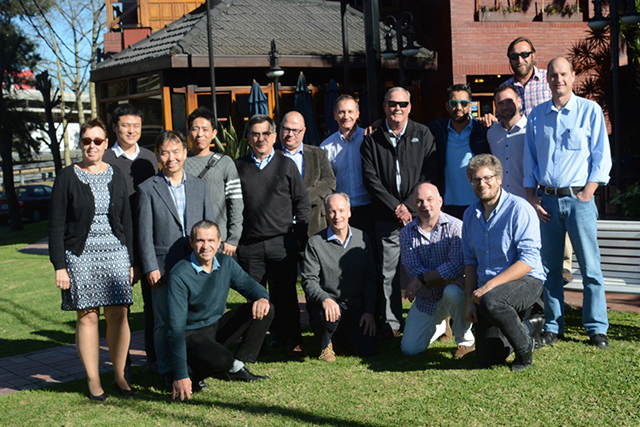
Caption: Catching up in Argentina in July at the IWCG meeting are members of the International WearCheck Group (IWCG). Members hail from all parts of our planet, including South Africa, Argentina, Hungary, South Korea, Spain, Canada, America, England and Belgium. WearCheck MD Neil Robinson is standing on the far right.
Published in
Blog
Wednesday, 02 August 2017 12:56
What works for you? Where could we improve? WearCheck is listening….

Every year, we invite you, our customers, to take two minutes (literally, 2 minutes!) of your time to suggest ways in which we can improve our service to you.
Your input and feedback helps us make important changes. And here’s a bonus - you’ll be entered into a lucky draw to win a Samsung tablet worth R4900!
At WearCheck we constantly strive to add extra value to our services, and we really do take your suggestions seriously.
Please give us your input. We have made it as quick and easy as possible for you – simply click here to enter ONLINE, or click here to PRINT the survey.
Go on, rate us now and stand a chance to win with WearCheck!
Published in
Blog