
Items filtered by date: Tuesday, 16 December 2025
Thursday, 09 January 2025 16:07
UNLOCKING LUBRICANT LONGEVITY: THE POWER OF RPVOT TESTING

There are multiple degradation pathways that turbine oil faces under operational stress, but the dominant failure mode in an operating system is oxidation, one of the primary causes of lubricant degradation.
Simply put, oxidation occurs when oxygen reacts with the hydrocarbon molecules in the base oil of a lubricant. The oxidation process is significantly accelerated by heat, with a 10°C increase in oil temperature effectively doubling the oxidation rate. Contaminants such as water, and metallic wear particles containing copper or iron, act as catalysts, further speeding up oxidation.
As oil oxidises, it forms acids and insoluble oxidation products, which can lead to formation of sludge or varnish. These degradation products can coat bearing and oil-cooler surfaces, preventing adequate cooling of the bearings. Areas with tight tolerances such as hydraulic control valves can also become coated, causing operational issues. What’s more, as the oil oxidises, its foam control, demulsibility and air-release characteristics will likely deteriorate.
In a nutshell, poor oxidation resistance shortens the oil’s service life.
All turbine oils contain antioxidants, which serve as the base oil’s first line of defence against oxidation. However, like all additives, antioxidants are sacrificial in nature and must be monitored through advanced oil analysis to determine the oil’s remaining life. This allows for proactive planning of oil replenishment and maintenance activities.
One such advanced oil analysis technique is the Rotating Pressure Vessel Oxidation Test (RPVOT).
The RPVOT is an essential tool in the lubricant industry for evaluating a lubricant’s oxidation resistance, particularly for turbine oils, hydraulic fluids, and other industrial lubricants. This test is crucial for ensuring that lubricants can withstand the oxidative stress encountered during operation, thereby extending their service life and protecting machinery from premature wear.
Let’s take a closer look at how WearCheck performs RPVOT analysis using ASTM D2272 – Method B.
The test begins by placing a predetermined amount of the lubricant sample, along with distilled water and a copper catalyst coil, into a glass container. This container is then sealed and placed inside a rotating pressure vessel, which is filled with oxygen to a specified pressure and heated to a standardised temperature (typically around 150°C).
Initially, the antioxidant additives in the oil resist oxidation. However, once these additives are depleted, the oil starts to oxidise, leading to a pressure drop within the vessel. The test continues until the pressure drops by a predetermined amount, with the time taken for this drop indicating the oxidation stability of the sample.
Depending on the condition of the sample, the test duration can range from 200 minutes to over 3,000 minutes. The result is reported as the time, in minutes, required for the pressure drop to occur. A longer RPVOT time suggests better oxidation stability, indicating that the lubricant is more robust and capable of performing well under oxidative stress.
For industries where equipment reliability is paramount, performing regular RPVOT analysis is invaluable, as it provides an early warning of potential lubricant degradation issues that can escalate to unplanned downtime. The cost of changing the oil in an industrial turbine is substantial, so maximising lubricant life is key. However, the greatest financial benefit of advanced oil analysis techniques like RPVOT is improved machine reliability and overall operational integrity.
Published in
Blog
Friday, 13 December 2024 06:46
Enter WearCheck’s world of condition monitoring, and more …

You will find the magic worked by Extreme Pressure (EP) additives on metal surfaces, sustainable water-saving tips, useful transformer maintenance advice, a discussion on the power of RPVOT testing – these stories and loads more await you in our latest Monitor newsletter.
Looking to upskill? You can select your team’s 2025 training courses, and even sign up for our free monthly Toolbox Training sessions!
Published in
Blog
Thursday, 17 October 2024 12:19
SLIDING THROUGH TIME - part 4 of 4

Technical Bulletin 91 just slid onto our website! In this final part of the epic story spanning the progressive development of lubrication from Stone Age to Modern Age, we begin in the early 20th century. Here, the enthralling tale of how scientific progress in both North America and Europe had a major impact in the outcome of World War II is told. We are taken from the battlefields in Germany, to various laboratories and even a captivating court case in the USA between two of the world’s major oil giants.
We invite you to embark on the final chronicle of how a simple substance, oil, has propelled civilisation. Click here: https://www.wearcheck.co.za/shared/TB91.pdf
Published in
Blog
Tuesday, 20 August 2024 09:51
Transformers, thermography, 1,000km car rally and more!

A bumper edition of our Monitor newsletter is hot off the press today! It is bursting with interesting stories on anti-wear additives, the huge milestones achieved by our diagnostics team, WearCheck’s support of the epic rally in aid of cancer in Namibia, an overview of water treatment, key insights into thermography and a new course, impressive staff accomplishments, a useful transformer tip, a warm welcome to new members, information on all our upcoming training courses, and lots more!
Download your copy for free here Monitor 94
Published in
Blog
Monday, 20 May 2024 08:55
SLIDING THROUGH TIME - part 3 of 4

Technical Bulletin 90 – hot off the press – continues on the fascinating journey through the history of lubrication, from Stone Age to Modern Age. In this issue, readers take off into the Golden Age of Flight in the early 20th century. What follows is an exploration of how two world wars drove innovation and technological advances in aeroplane engines and a host of related machinery. Additionally, automobiles drove massive advancement in engine lubrication, with the launch and development of the Model T Ford and combustion engines. You can read about all the key players in this era, from scientists to entrepreneurs, innovators, pilots, manufacturers and more.
Download Technical Bulletin 90 for free here Technical Bulletin 90
Published in
Blog
Wednesday, 20 March 2024 11:33
Getting to know the ropes, with WearCheck’s rope-testing team

Asset health, thriving productivity and profitability, minimised unscheduled maintenance and maximised team safety – these are among the goals for most industrial operations, including mines, quarries, construction projects and others.
A key step towards achieving these goals is knowing the condition of all operating equipment and components at any given moment. This means that constant monitoring is important.
Specialist condition monitoring company, WearCheck, empowers industrial operations with accurate insight into the condition of assets, enabling maintenance crews to optimise the health of an expansive array of machines and their components, using many different testing techniques.
The company serves as a hub for specialised teams that focus on monitoring different aspects across various sectors. In addition to its core service - the scientific analysis of used oil and other fluids – WearCheck also provides advanced field services (AFS) asset reliability care (ARC), scientific water analysis, transformer oil analysis and lubricant-enabled reliability (LER) services.
Through these monitoring techniques, WearCheck’s team of scientists, technicians and diagnosticians can assist customers to ensure that major, unscheduled equipment failure is avoided. This saves both time and money for industrial operations, and boosts productivity and safety.
The AFS team consists of experienced, highly skilled technical operators, who conduct technical compliance, non-destructive testing and rope testing.
This is a discussion around Rope Condition Assessment (RCA), where the integrity of steel wire ropes is tested to the relevant SANS Codes of Practice, and OEM or international standards.
Why test ropes?
To ensure that the required safety standards are met, WearCheck’s AFS team complies meticulously with the strict regulations set out in the South African National Standards (SANS) 10293:1996 Code of Practice for Steel Wire Ropes and various other relevant SANS Codes of Practice, which state that, “Conservatism must prevail where the safety of people or the continuity of production is involved, and great accuracy is not achievable. For the rope condition assessment inspector, the most important issue is reliability of defect detection in terms of the prescribed standard. Sound knowledge and understanding of component behaviour under the given service conditions is indispensable to all parties concerned.”
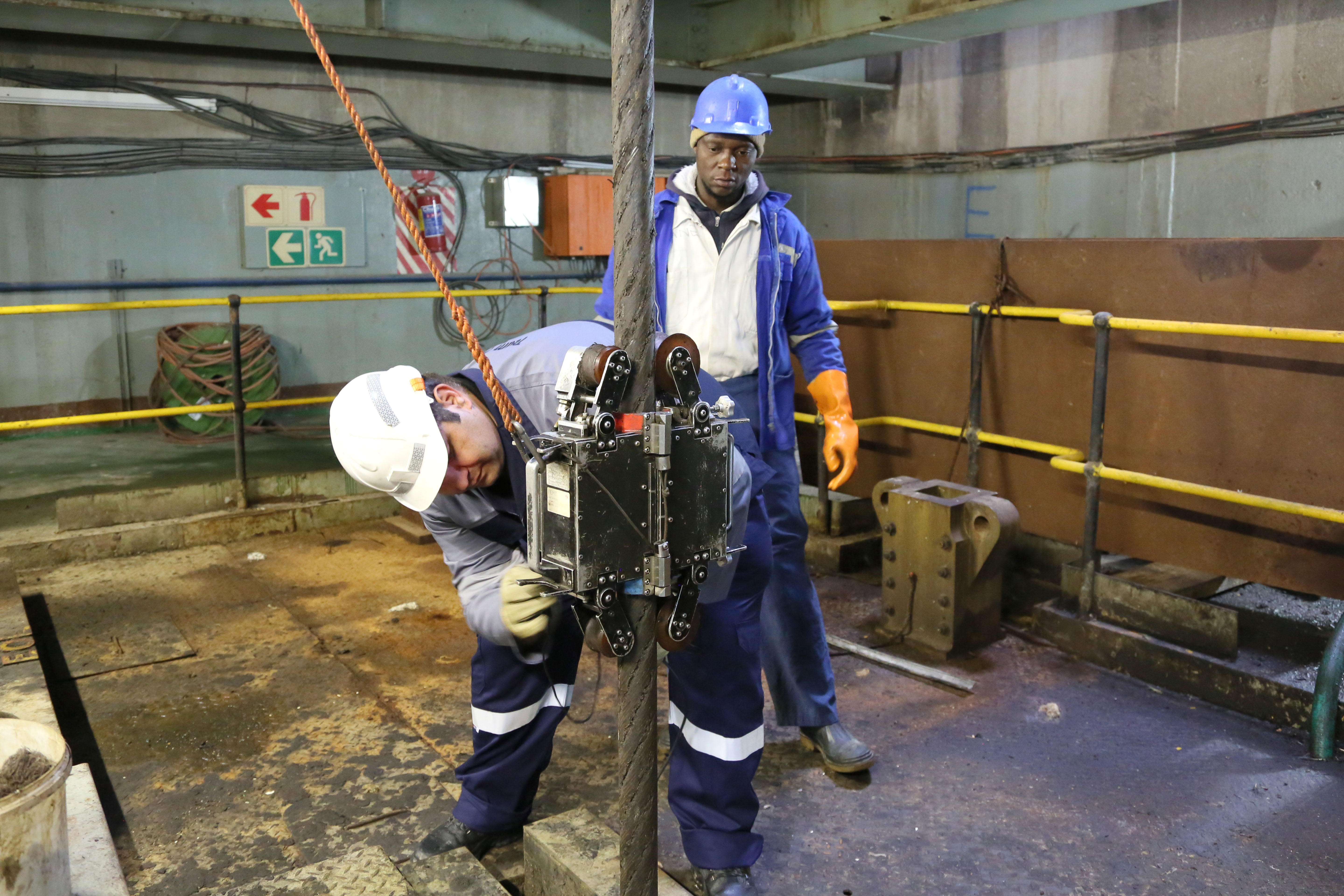
Roger Herrwood of WearCheck doing rope testing
The rope-testing process
Paul Musgrove is WearCheck’s AFS operations manager. He outlines the testing process. ‘We use a standard set of instruments to test a variety of different steel wire ropes. This includes a magnetic rope test instrument, which is affixed to the rope. All WearCheck’s RCA instrumentation is calibrated annually by an independent third-party service provider.
‘It magnetises the rope, feeds back information to an on-site computer, and detects anomalies such as corrosion, broken wires, wear, plastic deformation and many other problems that can occur in ropes,’ says Musgrove.
‘We can assess and apply the relevant discard criteria to a rope which has been compromised. The anomalies are calculated, test results analysed, and we advise the rope maintenance team immediately where corrective action is needed.
‘Non-destructive test methods are conducted on site, so that healthy ropes can continue in their normal operation until they have reached the end of life, based on the applicable discard criteria.’
How often should ropes be checked?
For licensed winders, RCA is generally done every 30 days, not exceeding every 40 days. The RCA, on chairlift ropes and unlicensed winder ropes, is gusually done at frequencies as determined by the relevant legally appointed engineer at all the relevant sites. The site engineers are obliged to adhere to the applicable legislation. WearCheck’s rope inspectors stick to a regular testing schedule of all the ropes in their care.
What industries use RCA?
RCA is conducted largely in the mining industry, where double drum winders, chair lifts, elevators and other steel wire rope components are regularly checked.
Also, rope manufacturers rely on RCA as a means of ensuring compliance with quality specs during the quality assessment (QA) process in the production of new ropes.
Who can conduct RCA tests?
The process of qualifying as an RCA inspector is particularly rigorous, to ensure that extreme safety measures are in place. There are currently only about 12 people in South Africa who are qualified to conduct rope condition analysis, and six of these technicians work at WearCheck.
The highly specialised certification process calls for an artisanal qualification, an N5 certificate, at least 18 months’ supervised work experience in the industry, and two written and practical exams, which must be passed with a minimum of 75%.
WearCheck’s extensive network of laboratories
WearCheck provides condition monitoring services throughout Africa, the Middle East and India – the company’s comprehensive network of 16 laboratories spans the continent and beyond, with a presence in nine countries.
WearCheck serves customers in a range of industries, some of which include mining, automation, manufacturing, wind turbines and power generation, earthmoving, industrial, transport, shipping, aircraft and electrical operations.
The company has established laboratories near industry/mining hubs in several countries, all of which are situated within easy reach for customers. In addition to the labs in South Africa, there are laboratories in Zambia, Zimbabwe, Namibia, Mozambique, DRC, Ghana, Dubai and India.
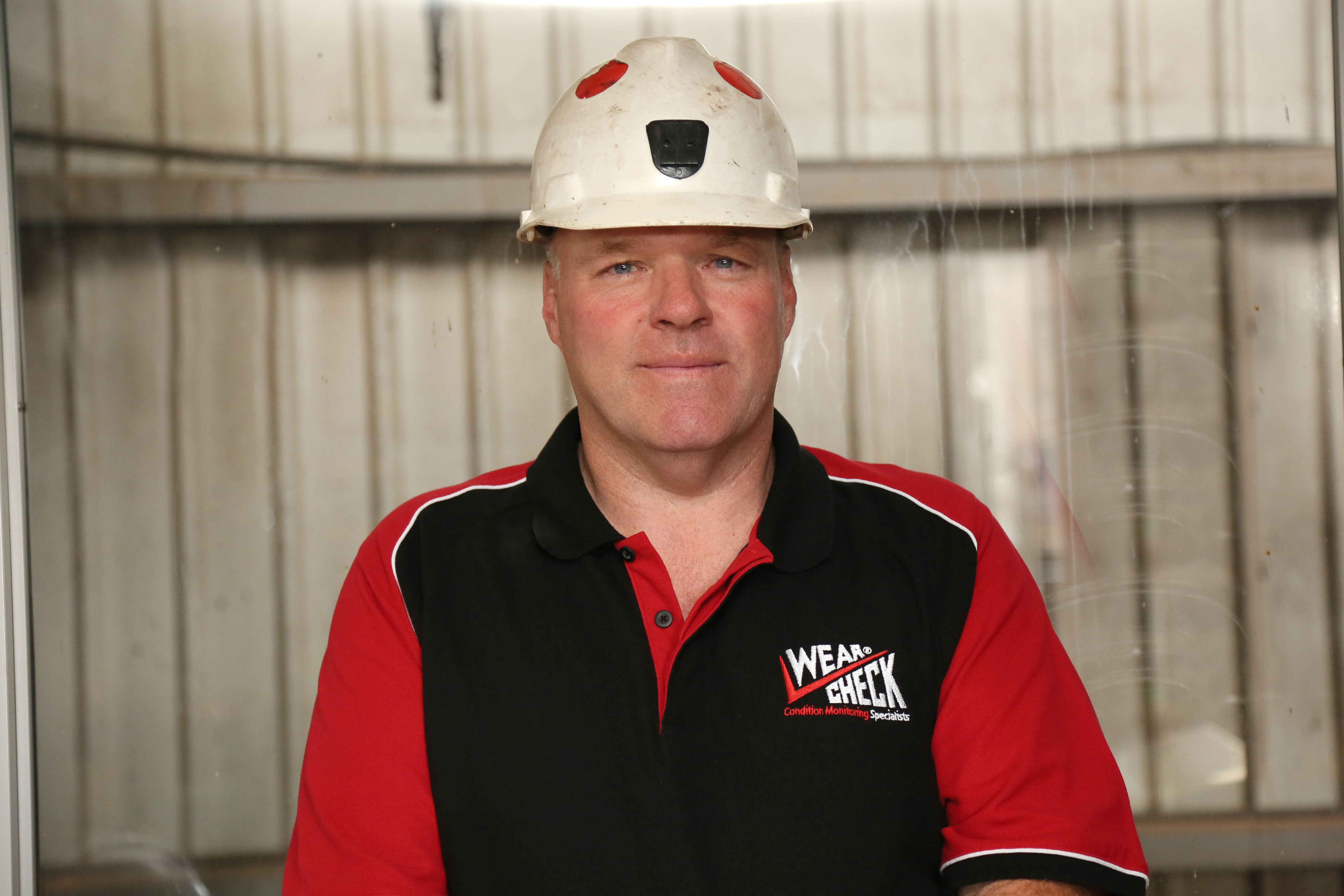
Paul Musgrove, WearCheck
For more information, please visit www.wearcheck.co.za, email This email address is being protected from spambots. You need JavaScript enabled to view it. or This email address is being protected from spambots. You need JavaScript enabled to view it. or call WearCheck South Africa +27 (31) 700-5460.
Published in
Blog
Wednesday, 21 February 2024 12:25
SLIDING THROUGH TIME (Part 2 of 3)

In part one of Lubrication from Stone Age to Modern Age (WearCheck Technical Bulletin 88), we slid through 5,000 years of lubrication history and left off at the end of the age of enlightenment in the early 1700s. The next leg of our journey finds us smack bang in the middle of the age of revolution, and a cascading series of events that led to the birth of the modern petroleum industry.
We explore both the first industrial revolution (The Age of Steam) and the second one (The Age of Electricity), and discover just how profoundly the people and advancements in these eras shaped the evolution of lubrication.
Along the journey, you will encounter many colourful characters and interesting events in this fascinating period of lubrication history, which incorporates many different countries, including Canada, the USA, Great Britain, Germany, the Netherlands, and others.
Please follow this link for the full story: https://www.wearcheck.co.za/shared/TB89.pdf
Published in
Blog
Monday, 04 December 2023 09:13
SLIDING THROUGH TIME

From stone age to modern age, pharaohs to phenols, the history of lubrication is a story that demonstrates how a seemingly simple substance - oil - has propelled human progress, shaped industries, and ushered in a world of smoother operations and optimised performance.
Now, while the field of tribology - which is the science of friction, wear and lubrication - has advanced significantly over the last 100 years, the roots of lubrication extend back further than one might imagine. Lubrication, in its simple form, has been in existence at least since the beginning of documented times.
Early humans recognised the importance of reducing friction, and intuitively understood that applying a lubricant between two surfaces would ease their movement. Before the Common Era, tallow (animal fat) and naturally occurring elements were used for lubrication for chariots and in transporting construction materials. In fact, one of the earliest examples of tribological practices can be found in the ancient Egyptians’ use of lubricants to reduce friction in the movement of large stones during the building of the pyramids. Other ancient civilisations like the Greeks and Romans used olive oil and other plant-based oils as lubricants.
Fast forward past the dark ages, (trust me, nothing much happened with lubricant development then) and twelve centuries later, tribology as a scientific discipline begins to take shape during the Renaissance with our favourite Italian polymath - Leonardo da Vinci - whose observations about friction and lubrication laid the foundation for further exploration.
Before the dawn of the industrial revolution, whale oil was commonly used as a lubricant, but with the worldwide decline in whale populations and the widespread use of machines, other sources of lubricants had to be found.
The discovery of crude oil in Pennsylvania in 1859 set the stage for the new oil economy, and led to the development of petroleum-based lubricants, which quickly replaced animal- and vegetable-based lubricants due to their superior performance and availability.
Today, lubricants are highly developed, using complex chemical methods designed to push their potential to the absolute limit. There are specific oils formulated for specific purposes, and our machines - from shipping, to transportation, to industrial factories - work faster and more efficiently than ever before. Our world could not function as it does today without modern lubrication advancements.
But how did we get here? Who first decided that mechanical lubrication was a good idea? And who helped develop these processes over thousands of years to get us to where we are today?
In this trip down memory lane, we will chronicle the significant milestones of lubrication through the ages - but don’t be fooled, this isn’t your run-of-the-mill timeline of notable inventions and courtly characters. Au contraire, like all good sagas, this tale is filled with intrigue and subterfuge, heroes and villains, great victories and heartbreaking defeats, all played out against the backdrop of human progress.
So, join us as we pay tribute to the true significance of these early achievements and the remarkable people through history who pioneered an industry.
To read more about this interesting topic, click here: https://www.wearcheck.co.za/shared/TB88.pdf
Published in
Blog
Friday, 17 November 2023 12:09
QUALITY – it’s at the heart of everything we do!

November heralds World Quality Month, a global celebration that resonates profoundly at WearCheck. This annual observance aligns seamlessly with our core mission – delivering unparalleled quality services.
At WearCheck, our commitment to Continuous Quality Improvement (CQI) is unwavering. Rigorous audits from esteemed bodies such as SANS (South African National Standards) and SABS (South African Bureau of Standards) are routine for our services.
Distinguishing itself on the African continent, WearCheck stands as the sole company holding multiple quality confirmation certificates, including ISO 9001:2015, ISO 14001:2015 certification, and ISO/IEC 17025:2017 accreditation. These accolades undergo regular scrutiny, with our track record showcasing a flawless renewal of accreditations and certifications.
Peace of mind
Our relentless pursuit of top-notch service is a source of pride, offering our clients the assurance that WearCheck's laboratory results and analytics are scientifically accurate, fostering peace of mind.
ISO 14001, earned in January 2005, underscores WearCheck's commitment to international standards governing environmental responsibilities. ISO 9001, initially awarded in 1996, acknowledges our integrated design, development, and provision of condition monitoring services to global standards.
ISO/IEC 17025, the international benchmark for laboratory competence, was first awarded to WearCheck’s Water Laboratory in 2003, followed by our Specialist Laboratory in 2012. Since then, our Water Laboratory has added various methods to our schedule, the latest being Microbiology methods under ISO/IEC 17025:2017 Accreditation.
Benefits for our customers
The benefits for our clients are manifold. The globally recognized ISO 9001:2015 standard holds sway, with some customers insisting on certified companies due to the assurance that management systems undergo continual assessment and enhancement.
The advantages extend to improved quality and service, punctual delivery, a right-first-time approach, minimised error incidence, enhanced reporting and communications, superior products and services, dependable production scheduling and delivery, and the perpetuation of standards through annual assessments.
The ISO system not only fosters an efficient management process but is also a prerequisite for tendering in certain public sector projects. Beyond the tangible benefits, certification sends a positive message to both customers and staff, simultaneously reducing costs by spotlighting time-saving procedures. At WearCheck, World Quality Month is not just a celebration; it's a reaffirmation of our unwavering commitment to excellence.
Published in
Blog
Wednesday, 18 October 2023 11:49
WEARCHECK EXPERTS TO ADDRESS SAIT FUEL SEMINAR

Diesel, the importance of its cleanliness and how to maintain the correct chemical composition, will be in the spotlight at the South African Institute of Tribology (SAIT) Fuel Seminar, which takes place on 10 November in Johannesburg.
Two of WearCheck’s fuel specialists will be presenting papers on how to get the best ROI from fuel, which is a major expense in many operations. Running a cost-efficient, lean operation can be achieved by applying these insider tips to ensure that fuel performs as it should, without causing collateral damage as fuel condition deteriorates.
WearCheck diagnostician, Quinton Verster, will talk on the tests available to determine the quality of diesel, with a focus on the South African National Standard SANS 342, which stipulates the legally allowed sulphur and biodiesel content of automotive diesel fuel, among other qualities. Verster will discuss test methods, instrumentation and actual limits, and the associated hazards of different readings.
Lubrigard manager for WearCheck, Chris Hattingh, will discuss the importance of keeping diesel clean and free from particulate contamination, giving advice on the best methods for fuel storage, dispensing and maintenance. Hattingh runs the company’s LER (lubricant enabled reliability) services which focus on FLAC - fuels, lubricants, air and coolants. In many industries, potential contamination negatively affects performance of fuels, so it is critical to eliminate sources of contamination, and monitor contamination levels constantly.
The seminar takes place at The Manor Executive Guest Lodge in Kempton Park. Booking is essential – please contact Jo-anne at SAIT on telephone (011) 804-3710 or email This email address is being protected from spambots. You need JavaScript enabled to view it..
Looking for more information on fuel condition monitoring? WearCheck has published many Technical Bulletins around this topic. You can view them here, for free: https://www.wearcheck.co.za/info/publications/technical-bulletin.html
Published in
Blog