

Francis Berner
Monday, 25 May 2026 11:02
Read all about it - the latest Monitor newsletter is here!

The latest edition of the WearCheck Monitor newsletter is out now, and it is packed with useful technical insight, company news and community updates.
This bumper issue takes a closer look at the hot topic of diesel adulteration – including why it matters, how it affects machinery reliability, and how laboratory testing can help identify compromised fuel. We also feature an informative article on lubricant degradation, explaining what happens as lubricants age and why regular monitoring is essential for protecting equipment.
Other technical highlights include our new on-site sampling service, a practical transformer maintenance tip, and an overview of key updates to SANS 241:2025, the South African National Standard for drinking water safety.
There is plenty of company news too. Meet some of our intrepid WearCheck team members who travel far and wide to deliver technical training, read about our new agent in Tanzania, and enjoy several feel-good stories from our latest WeCare community upliftment projects.
Our training calendar also remains full, with courses scheduled every month – including our popular, free Toolbox Training sessions. Browse the latest schedules and find a course that suits your needs.
Published in
Blog
Tagged under
Wednesday, 04 February 2026 11:47
When Good Oils Go Bad
There are certain things in life that improve with age. Wine and whisky develop deeper, more complex flavours. Bonsai trees mature into highly valued works of art and even acoustic guitars and violins are said to improve in tone as the wood ages and the instrument opens up.
Unfortunately, the list of things that don’t improve with time is far longer. Our physical health declines, sometimes along with our sense of humour. Metals corrode, paint fades and, perhaps less romantically but more relevantly, lubricants also age.
Unlike wine or instruments, however, lubricants are not designed to get better with age.
Lubricants rarely fail suddenly. They don’t just wake up one morning and decide to stop working, and they don’t usually announce the end of their useful life with dramatic symptoms. Usually, a lubricant quietly ages, reacts, and is slowly consumed by the environment in which it operates. By the time a problem becomes obvious, the oil has usually been struggling for some time. This is what we mean when we say, “when good oils go bad”.
A lubricant doesn’t become “bad” simply because it has darkened, developed an odour or been in service for a period of time. These changes are often early symptoms of degradation, but they do not, on their own, define failure. A good oil goes bad when it can no longer perform the functions it was designed to perform. So, what is a lubricant actually supposed to do?
|
A fully formulated lubricant is far more than just “oil.” It’s a carefully balanced blend of base oils and additives designed to perform several critical functions all at the same time. While the specific functions vary by application, they generally fall into five fundamental groups. Firstly, lubricants are used to reduce friction and wear between moving surfaces. By maintaining a protective film, the oil limits metal-to-metal contact and helps prevent mechanical damage. Secondly, lubricants play a vital role in dissipating heat. As machines operate, friction, load, and in some cases combustion, generate heat that must be removed from critical components. The lubricant acts as a heat-transfer medium carrying thermal energy away from high-temperature zones. |
  |
Thirdly, lubricants are expected to remove and suspend deposits. Contaminants like wear debris, soot and oxidation by-products must be kept in suspension and carried away from sensitive surfaces so they can be removed by filtration or oil changes.
Fourthly, lubricants are formulated to protect metal surfaces from corrosion and chemical degradation. Additives are included to neutralise acids, inhibit rust and prevent chemically aggressive species from attacking machine components.
And finally, a lubricant acts as a structural material. Viscosity, film strength and load-carrying capacity determine whether the oil can physically separate surfaces under operating conditions. If the oil film collapses, the lubricant can no longer do its job.
As long as a lubricant can perform these functions, it is still “good.” When one or more of these functions is compromised, the oil may still be present in the system, but it is no longer fit for purpose.
From degradation to lubrication failure
Lubricant degradation is often the first step on the path toward lubrication failure, but the two are not the same.
Degradation refers to the gradual chemical and physical changes that occur in an oil during service. Additives are consumed, base oils react with oxygen, contaminants accumulate and operating stresses take their toll, yet - initially - these changes may not significantly affect machine operation.
Lubrication failure, however, occurs when degradation has progressed to the point where the oil can no longer protect the equipment. At that stage, wear rates increase, temperatures rise, deposits form, corrosion accelerates and component damage becomes likely.

The critical distinction is that degradation begins long before failure becomes visible or irreversible. Understanding this gap between degradation and failure is what allows corrective action to be taken in time.
This is where oil analysis plays a vital role - not as a post-mortem tool, but as a means of detecting lubricant degradation early while intervention is still possible.
Why do oils degrade at all?
Even the best lubricant operating in well-maintained equipment under favourable conditions has a finite life. Oils degrade because they are continuously exposed to stresses that slowly change their chemistry and performance.
Heat accelerates chemical reactions while oxygen drives oxidation. Contaminants such as water, fuel and soot interfere with additive performance and promote further oil degradation, and mechanical stresses can break down polymeric additives like viscosity index improvers. Over time, the very additives designed to protect the oil and the machine are consumed doing their job.
|
What is important to note is that these processes do not occur in isolation. Multiple degradation mechanisms are usually active at the same time interacting with and accelerating one another. This is why lubricant degradation can be difficult to interpret without understanding how and why these changes occur. In this WearCheck series, When Good Oils Go Bad, we will explore the main ways lubricants degrade in service and how these degradation modes affect oil performance and machine reliability - from oxidation and nitration to thermal breakdown, microdieseling, electrostatic spark discharge, additive depletion and contamination. |
 |
By understanding how lubricants degrade, it becomes easier to interpret oil analysis results, identify emerging risks and make informed maintenance decisions. After all oils don’t die - they degrade, and the earlier we understand that process, the better we can manage it.
Like people, lubricants age whether we notice it or not - the difference is that with oil analysis, at least the oil can’t lie about it.
Look out for the next instalment of this series.
Published in
Blog
Tagged under
Monday, 26 January 2026 13:21
WE’RE TALKING RELIABILITY AT MINING INDABA 2026

WearCheck will once again be part of the 2026 Investing in Africa Mining Indaba, taking place from 9 to 12 February at the Cape Town International Convention Centre.
At the event, the WearCheck team will be showcasing a wide range of condition monitoring and predictive maintenance solutions designed for the mining environment. From used oil analysis and transformer oil testing to asset reliability services and scientific water analysis, the focus is on helping mines reduce unplanned downtime, extend component life and improve overall performance.
WearCheck works closely with mining operations across Africa, providing practical tools and programmes that support a shift from reactive maintenance to proactive, data-driven decision-making. By combining laboratory diagnostics with on-site technical services, mines gain a clearer, more complete picture of equipment health.
Visitors can find WearCheck on stand [number], hosted by marketing manager Vanessa Evans. Technical specialists will be available throughout the event to share real-world applications, explain recent developments across the business and demonstrate how predictive maintenance technologies can be built into everyday maintenance strategies.
At the core of WearCheck’s offering is the scientific analysis of used oil, fuel and other fluids. By examining samples for microscopic wear debris and early warning indicators, potential faults can be identified long before failure occurs. Results are interpreted by specialist diagnosticians who highlight trends and, where necessary, recommend corrective action – enabling maintenance teams to intervene early.
Beyond fluid analysis, WearCheck offers a suite of complementary predictive maintenance services tailored to different equipment types and operating conditions. These include asset reliability care services, transformer chemistry services and advanced field services such as non-destructive testing, technical compliance and rope condition assessment. Lubrication-enabled reliability services further support consistent, efficient lubrication practices on site.
The company also provides scientific water testing through its dedicated water division, assessing wastewater, groundwater and surface water at mining and exploration sites. This supports both operational requirements and environmental responsibilities, helping mines meet compliance standards, manage discharge responsibly and reduce risk to surrounding water resources.
As WearCheck marks 50 years in business this year, the company continues to focus on what it has always done best – helping mines stay productive by identifying potential problems early, before they have a chance to impact operations.
Published in
Blog
Tagged under
Tuesday, 09 December 2025 10:41
The Monitor newsletter is published!

The latest WearCheck Monitor newsletter features our Festive Season opening hours, along with interesting discussions about the role of AI in machinery maintenance, lubricant sampling valves, the new Lubrigard website and Adblue.
The customer survey lucky draw winner is announced, we offer you some transformer tips and a lube tip, and we share some heartwarming stories about our social responsibility programme – WeCare.
You can plan your team’s training courses for 2026 – our full training calendar is included in the newsletter.
You can read Monitor 98 here: https://www.wearcheck.co.za/shared/M98.pdf
Published in
Blog
Tagged under
Wednesday, 26 November 2025 16:19
WHY AI WILL NEVER TRULY UNDERSTAND MACHINES — AND WHY THAT MATTERS

By Annemie Willer, manager WearCheck ARC Division
Cutting-edge technology and solutions powered by artificial intelligence (AI) are embraced by WearCheck, where the extreme accuracy of data used to assess and diagnose machine health is paramount.
However, it is important that certain diagnostic responsibilities are not just assigned to AI tools without considering the need for human intervention and experience.
We keep hearing worrying claims from industry stakeholders and customers that if you throw enough data from vibration, oil, thermography, process sensors, ultrasound, and AE (acoustic emission) into an AI system, it’ll somehow converge into a perfect picture of machine health, complete with the exact corrective action to take.
It’s a nice idea. In fact, it sounds like the future. But I don’t buy it.
Importantly, this is not because I’m anti-technology — quite the opposite, in fact. I’ve worked in diagnostics long enough to see the value of every tool we have. But I’ve also been around long enough to know this: machines don’t behave according to theory. And AI doesn’t understand that.
For example, I keep encountering the myth of “convergence” — the idea that all condition monitoring technologies can fuse into one holistic truth, which assumes that machines behave in predictable, repeatable ways.
But they don’t.
You can install ten pumps from the same OEM, running under the same process conditions, in the same plant, with the same lube, and still... they won’t age the same. One might run clean for six years. Another might seize up in eight months. And no amount of sensor data is going to tell you why - not reliably.
Why? Because machines are not clones. They're flawed. They are manufactured to tolerance, not perfection. Machined surfaces differ microscopically, and assembly is never identical. And once you add human hands, production targets, rushed shutdowns, and midnight shift decisions into the mix — good luck feeding that into an algorithm!
It is important to take the real-world situation into account when assessing an asset. AI relies on data, but data only captures what the sensors see — not what the human maintainer did when nobody was watching. It does not record the subtle looseness that a technician "felt" but didn’t log. It does not register the fact that someone topped up the wrong grease, or skipped torque checks, or ran a fan uncoupled for three minutes at startup.
No historian records that. And without that real-world information, AI is flying blind on the stuff that actually causes most failures.
I believe that every condition monitoring technology has its place — and its limits. For example, vibration monitoring tells us about mechanical behaviour; oil analysis identifies lubricant condition and contamination; thermography picks up heat and load imbalance, AE and ultrasound testing give early warnings of friction, turbulence, or sparking; and process data provides the operating context — but not the root cause of failure.
These monitoring techniques and their test results don’t converge neatly. They weren’t designed to. One doesn’t combine them to get a better truth — rather, they should be compared to demonstrate different perspectives. That’s what makes condition monitoring powerful: it’s a team effort, not a solo act.
Can we rely on AI?
AI is useful, just not the way that the vendors keep claiming. It can spot changes over time. It can rank the risks, it can filter out noise and highlight anomalies - all of this is valuable.
Importantly, however, AI cannot know the history of every shaft and housing. It cannot understand why a lube change worked for one gearbox and not the next.
It cannot interpret subtle mechanical behaviour that only a human technician would notice, and it cannot predict how different people on different shifts handle the same piece of equipment.
In other words — AI can help one find where to look, but not what to do when you get there.
I have always told our customers that machines are messy, and that this is not a problem, it is merely the reality. Here’s the truth: machines have personalities. Not literally, of course, but in how they wear, respond, and behave under pressure. And a lot of that has nothing to do with engineering design or process control. It has to do with maintenance history, human touch, and physical realities that no AI-powered model — however sophisticated — can learn.
The idea that AI will converge all technologies into one correct decision ignores this complexity. It reduces the craft of diagnostics to a logic problem, when in truth, it’s part science, part art, and always tied to context.
Let AI support us. Let it help us scale, see patterns, and work smarter. But let’s stop pretending it can replace understanding — or diagnose machines like a seasoned engineer can. Because machines don’t live in the cloud. They live in the real world. And in the real world, convergence isn’t the goal. Clarity is!
Published in
Blog
Tagged under
Monday, 17 November 2025 18:11
KEEPING IT REAL – WEARCHECK’S ONGOING COMMITMENT TO GENUINE QUALITY
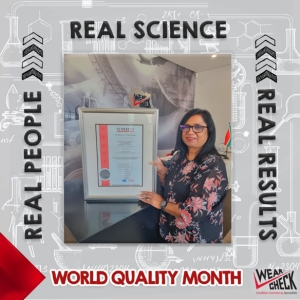
In a world where deepfakes and fake claims blur the line between real and manufactured, authenticity matters more than ever. That’s why this November – World Quality Month – WearCheck is proudly reaffirming its commitment to real, verifiable quality.
For us, quality isn’t a buzzword. It’s the everyday standard that defines how we work — from the rigour of our scientific laboratory methods to the professionalism of our customer service.
A Legacy of Trust, Built on Certification
Our recent re-certification to ISO 9001:2015 by the South African Bureau of Standards (SABS) reinforces this commitment. WearCheck first earned ISO 9001 certification back in 1996, and added ISO 14001 in 2005. Every year, we undergo surveillance audits and, every three years, a full re-certification. It’s not a tick-box exercise — it’s how we keep our systems robust, our processes consistent, and our team focused on continual improvement.
As our Quality Administrator, Prinda Narasi, puts it:
“Our customers, especially fleet operators, rely on us for results they can trust. ISO 9001:2015 is independent confirmation that our systems are sound and our culture is built around quality. In a time when manipulated content can cloud judgment, verifiable, third-party certification helps customers separate marketing claims from proven capability.”
Why It Matters
For the transport sector, ISO 9001:2015 means dependable turnaround times, a right-first-time mindset, and clear, actionable reporting. It ensures every oil, fuel or coolant sample analysed by our team provides accurate, timely insights — the kind that support better maintenance decisions and longer equipment life.
Transparency Builds Trust
We always encourage our customers to verify supplier certifications. It’s easy to do: simply check with the issuing certification body or its online directory. Sadly, non-genuine certificates are not uncommon across industries. At WearCheck, we welcome verification — because transparency is part of the trust.
Quality Is How We Work
Our quality system isn’t something we “dust off” once a year. It’s alive and active — driven by internal audits, management reviews, risk-based thinking, and ongoing staff development. It’s this continuous focus that ensures consistent, reliable results in our laboratories and responsive support for our customers.
For nearly three decades, WearCheck has maintained multiple international quality confirmations, including ISO 9001:2015, ISO 14001:2015, and ISO/IEC 17025:2017. We’ve never failed a renewal — and we don’t plan to start now.
Because when we say quality, we mean real quality — delivered by real people, using real science, for real results.
Published in
Blog
Tagged under
Thursday, 30 October 2025 12:23
Precision in every drop – powered by ICP technology

Inductively Coupled Plasma – Optical Emission Spectroscopy (ICP-OES) turns a small oil sample into clear maintenance intelligence. The sample is nebulised into an argon plasma, where atoms are excited and then emit light at element-specific wavelengths in the UV/visible range. The intensity at those wavelengths is proportional to concentration, which means that metals and additives can be quantified precisely against calibration curves.
In the latest high-tech ICP instruments at WearCheck, modern Echelle optics with CCD/CID detectors capture many wavelengths at once, enabling fast, simultaneous multi-element analysis with excellent sensitivity and selectivity. Rigorous calibration underpins accuracy: certified reference materials, tight linearity (very high R² values), daily calibration checks, scheduled services and periodic method validation keep results reliable across different lubricant types.
High-throughput autosamplers enable us to process 100+ samples per hour, with multiple rapid reads per sample to strengthen precision. Automated quality controls pause analysis if anything falls out of spec. Aligned to recognised methods (such as ASTM D5185), this approach provides consistent insight into additive health, contamination and component wear, helping teams decide if oil is fit for service, spot abnormal wear early and plan interventions before minor issues become failures. In short, WearCheck offers faster turnaround, lower detection limits and data you can trust.
For a deep-dive into our ICP offerings, you can read our latest Technical Bulletin 94, which can be downloaded here.
Published in
Blog
Tagged under
Thursday, 21 August 2025 12:45
Our latest Monitor newsletter is ready!

Dissolved gas analysis, rheology, advanced legionella testing, top transformer tips and even a chance to win a prize worth R6,000 – these are just some of the stories featured in the latest WearCheck Monitor newsletter.
We also bring you news of international and local expos and conferences where WearCheck was present, and a heartwarming story about some very special blankets, which were knitted by one group of grannies and donated to another group of grannies.
Technical training for maintenance staff is an investment which yields excellent returns. Check out our latest schedule of upcoming customer training courses, which focus on more than 12 different areas of condition monitoring.
You can read Monitor 97 here: WearCheck Monitor 97
Published in
Blog
Tagged under
Monday, 14 April 2025 11:11
WEARCHECK WATER EARNS ACCREDITATION FOR MICROBIOLOGICAL TESTING
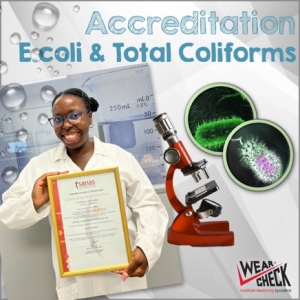
Great news from the WearCheck Water team — our Johannesburg lab has just earned ISO/IEC 17025 accreditation for testing Total Coliforms and E. coli in water. This follows a detailed audit process and adds another feather to our cap when it comes to delivering top-quality testing services.
What It Means for Our Customers
This new accreditation gives our clients — both in South Africa and beyond — even more confidence in the work we do. It proves our team is working to the highest international standards when it comes to microbiological testing.
WearCheck Water is part of WearCheck, a specialist condition monitoring company. We’re proud to be the only oil analysis company in Africa with ISO 9001 (quality), ISO 14001 (environmental), and ISO/IEC 17025 (lab quality) certifications — and now our water division is even stronger with this latest win. We also recently received SANAS accreditation for testing AdBlue®/DEF (diesel exhaust fluid).
Why This Testing Matters
General Manager of WearCheck Water, Thelma Horsfield, explains:
“It takes months of hard work to develop the testing method and get it up to standard for SANAS approval. This accreditation confirms our lab’s ability to carry out precise and reliable water-quality testing.”
The method we use — membrane filtration — is a well-respected technique in water testing. It helps us identify and count total coliforms and E. coli in water samples.
Coliforms are bacteria often found in soil, plants, and surface water. Most are harmless, but their presence in drinking water could signal other dangerous contaminants. E. coli is a specific type of coliform found in the intestines of warm-blooded animals, and some strains can cause serious illness — so accurate detection is crucial for public health.
Celebrating Our People
A big shout-out goes to our lab assistant Khensani Mbuli, who played a key role in securing this accreditation. Thanks to her dedication and skill, she’s now been appointed an ISO/IEC 17025 Technical Signatory — a huge achievement in the world of lab testing!
Thelma explains: “Becoming a Technical Signatory is no small task. It takes deep knowledge, hands-on experience, and loads of training. TSs have the final say when it comes to signing off test results, so it’s a position of real trust and responsibility.”
Khensani joins six other senior Technical Signatories in our team: Moses Lelaka, Thelma Horsfield, Lerato Letsoalo, Lorato Hotane (our nominated rep), Katlego Mokoroane, and Michelle Wium.
Supporting a Range of Industries
WearCheck Water offers professional water analysis services across a variety of sectors — from mining and agriculture to manufacturing and fleet management. This latest accreditation is just one more way we’re proving our commitment to quality, reliability, and keeping water safe.
Published in
Blog
Tagged under
Tuesday, 25 February 2025 17:24
Crude awakening – part 1 of 4
You’re in for a ‘crude awakening’ when you download WearCheck’s latest Technical Bulletin! You will be treated to an in-depth explanation of the processes of producing oil, fuel and other petrochemical wonders that power our modern lifestyle. The epic tale about this almost magical process begins with the formation of the crude oil millions of years ago, and flows through all the stages of extracting, distilling, cracking, coking, refining and blending it into consumer-friendly products.
If you’d like to join us as we explore the molecular magic and unpack the chemistry behind crude oil, please download Technical Bulletin 92 here.
Published in
Blog
Tagged under