

Francis Berner
Friday, 17 November 2023 12:09
QUALITY – it’s at the heart of everything we do!

November heralds World Quality Month, a global celebration that resonates profoundly at WearCheck. This annual observance aligns seamlessly with our core mission – delivering unparalleled quality services.
At WearCheck, our commitment to Continuous Quality Improvement (CQI) is unwavering. Rigorous audits from esteemed bodies such as SANS (South African National Standards) and SABS (South African Bureau of Standards) are routine for our services.
Distinguishing itself on the African continent, WearCheck stands as the sole company holding multiple quality confirmation certificates, including ISO 9001:2015, ISO 14001:2015 certification, and ISO/IEC 17025:2017 accreditation. These accolades undergo regular scrutiny, with our track record showcasing a flawless renewal of accreditations and certifications.
Peace of mind
Our relentless pursuit of top-notch service is a source of pride, offering our clients the assurance that WearCheck's laboratory results and analytics are scientifically accurate, fostering peace of mind.
ISO 14001, earned in January 2005, underscores WearCheck's commitment to international standards governing environmental responsibilities. ISO 9001, initially awarded in 1996, acknowledges our integrated design, development, and provision of condition monitoring services to global standards.
ISO/IEC 17025, the international benchmark for laboratory competence, was first awarded to WearCheck’s Water Laboratory in 2003, followed by our Specialist Laboratory in 2012. Since then, our Water Laboratory has added various methods to our schedule, the latest being Microbiology methods under ISO/IEC 17025:2017 Accreditation.
Benefits for our customers
The benefits for our clients are manifold. The globally recognized ISO 9001:2015 standard holds sway, with some customers insisting on certified companies due to the assurance that management systems undergo continual assessment and enhancement.
The advantages extend to improved quality and service, punctual delivery, a right-first-time approach, minimised error incidence, enhanced reporting and communications, superior products and services, dependable production scheduling and delivery, and the perpetuation of standards through annual assessments.
The ISO system not only fosters an efficient management process but is also a prerequisite for tendering in certain public sector projects. Beyond the tangible benefits, certification sends a positive message to both customers and staff, simultaneously reducing costs by spotlighting time-saving procedures. At WearCheck, World Quality Month is not just a celebration; it's a reaffirmation of our unwavering commitment to excellence.
Published in
Blog
Tagged under
Wednesday, 18 October 2023 11:49
WEARCHECK EXPERTS TO ADDRESS SAIT FUEL SEMINAR

Diesel, the importance of its cleanliness and how to maintain the correct chemical composition, will be in the spotlight at the South African Institute of Tribology (SAIT) Fuel Seminar, which takes place on 10 November in Johannesburg.
Two of WearCheck’s fuel specialists will be presenting papers on how to get the best ROI from fuel, which is a major expense in many operations. Running a cost-efficient, lean operation can be achieved by applying these insider tips to ensure that fuel performs as it should, without causing collateral damage as fuel condition deteriorates.
WearCheck diagnostician, Quinton Verster, will talk on the tests available to determine the quality of diesel, with a focus on the South African National Standard SANS 342, which stipulates the legally allowed sulphur and biodiesel content of automotive diesel fuel, among other qualities. Verster will discuss test methods, instrumentation and actual limits, and the associated hazards of different readings.
Lubrigard manager for WearCheck, Chris Hattingh, will discuss the importance of keeping diesel clean and free from particulate contamination, giving advice on the best methods for fuel storage, dispensing and maintenance. Hattingh runs the company’s LER (lubricant enabled reliability) services which focus on FLAC - fuels, lubricants, air and coolants. In many industries, potential contamination negatively affects performance of fuels, so it is critical to eliminate sources of contamination, and monitor contamination levels constantly.
The seminar takes place at The Manor Executive Guest Lodge in Kempton Park. Booking is essential – please contact Jo-anne at SAIT on telephone (011) 804-3710 or email This email address is being protected from spambots. You need JavaScript enabled to view it..
Looking for more information on fuel condition monitoring? WearCheck has published many Technical Bulletins around this topic. You can view them here, for free: https://www.wearcheck.co.za/info/publications/technical-bulletin.html
Published in
Blog
Tagged under
Tuesday, 08 August 2023 11:48
ESTER-GAZERS SERIES: TYPES OF OIL TESTS AND THEIR SIGNIFICANCE

This article is part of a series and is based on reviews of the most commonly applied property tests as per available standards and guides. We will look at how to apply the values of each test to natural ester insulating fluid. The typical values and value limits for new and used ester oils differ primarily from those established for mineral oil.
Due to the inherent differences in chemical, electrical, and physical properties between natural esters and mineral insulating fluids, some standards still need to be updated. For that, some clarification of in-service data is required.
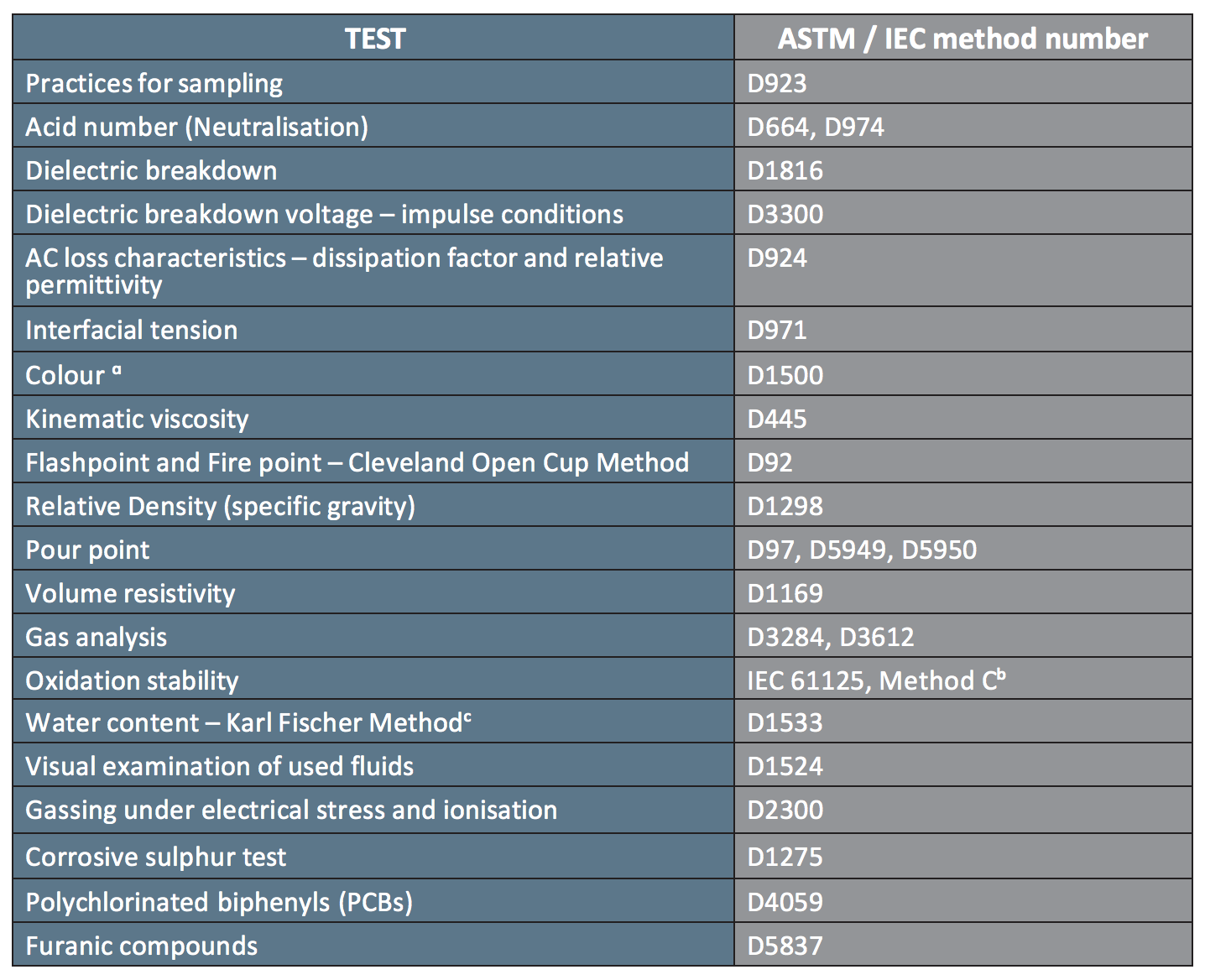
ᵅ NE insulating fluids tinted with dye by the manufacturer should not impact the test beyond the 1.0 limit ᵇ As modified in IEC 62770, Annex A (reducing the test duration from 164h to 48h)
ᶜ Alternative reagents as listed in ASTM D1533 for natural esters as modified in IEC 62770, Annex A (reducing test duration from 164h to 48h).
PRACTICES FOR SAMPLING (ASTM D923)
As with any sample, accuracy is critical to empower the diagnostic services to evaluate the product quality in the sample. Carelessness during the sampling process or contamination of the sample may lead to a misleading result that does not represent the body of fluid being analysed. This can lead to erroneous conclusions and recommendations, which may lead to unmerited expenditure or an incorrect reliability rating of units.
To read more about testing guidelines for natural ester oils in transformers, click here: https://www.wearcheck.co.za/shared/TB85.pdf
Published in
Blog
Tagged under
Monday, 31 July 2023 08:23
ESTER-GAZERS SERIES: TESTING GUIDELINES FOR NATURAL ESTER OILS IN TRANSFORMERS

In this series, we will discuss the different condition monitoring options for the analysis of transformer component performance where natural esters are used as lubricants in transformers.
Lubricants can be categorised in many different ways. One of the most common classifications is by the constituent base oil: mineral, synthetic or vegetable. Mineral oil, which is derived from crude oil, can be produced to provide a range of qualities associated with the oil’s refining process.
Natural esters, derived from 100% renewable vegetable oils, are superior to mineral oil for use in distribution and power-generation transformers of all voltage classes, both new and retrofilled.
Natural esters and mineral oils are miscible and mostly compatible; they are also compatible with halogenated hydrocarbon insulating fluids. Mixing mineral oil and natural esters may or may not significantly impact the typical properties of impact performance. If the property values change, it may or may not be proportional to the ratio of the content of the fluids.
NOTE: If the purpose of using the natural ester oil is to comply with the National Electrical Code, that would require that less-flammable fluids have an ASTM D92 fire point of not less than 300°C and that the installation complies with all restrictions provided for in the product listing of the fluid.
Too much mineral oil contamination of the natural ester might fail to meet the requirements of the Safety Code. The natural ester manufacturer should be contacted to determine the maximum mineral oil content range, that is allowed, to ensure that flammability parameters are met. Typically, a maximum of 7% mineral oil is acceptable.
As a rule, it is not advisable to mix synthetic esters, synthetic hydrocarbons, and high molecular weight hydrocarbons, although they are miscible. Silicone fluid is not miscible with natural ester oils, so cross contamination should be avoided. Typically, natural esters are miscible with non-flammable halogenated hydrocarbons, like PCBs. This might occur when retro filling older transformers that are filled with this insulating fluid. It would be advisable to consult the manufacturers in such a case
To read more about testing guidelines for natural ester oils in transformers, click here: https://www.wearcheck.co.za/shared/TB85.pdf
Published in
Blog
Tagged under
Thursday, 13 April 2023 10:35
CHOLERA IN DRINKING WATER

Cholera is the acute diarrhoeal infection caused by the ingestion of food or water that is contaminated with the bacteria called vibrio cholerae.
The infection can cause severe watery diarrhoea. It takes between 12 hours and five days for a person to show symptoms after ingesting contaminated food or water. The bacteria infect adults and children and can kill within hours if not treated.
How is cholera transmitted?
Cholera can be transmitted by ingestion of contaminated food or water. Sudden large outbreaks are usually caused by a contaminated water supply. Outbreaks and sporadic cases are often attributed to raw and undercooked seafood.

What are the symptoms of cholera?
- Profuse watery diarrhoea
- Vomiting
- Thirst
- Leg cramps
- Restlessness and irritability
- Dehydration
- Rapid heart rate
- Muscle cramps
Please note that many people do not develop symptoms, even though the bacteria are in their faeces for several days after infection, and are shed back into the environment – potentially affecting others. Young children can develop severe symptoms due to immature immune systems and under-developed immunity to a wide variety of common germs.
How do you prevent cholera?
- If you suspect that the water is not safe, treat it with chlorine/bleach products, boil it or filter it.
- Wash your hands often with soap and safe water.
- Use the toilet to get rid of faeces safely. It is important to teach young children the importance of using a toilet instead of defecating near a water source in the open.
- If at all possible, avoid travelling to areas or places with active cholera transmissions.
The WearCheck family has grown with the recent acquisition of Set Point Water Laboratories. Incorporating these specialised water analysis skills into our business, means we can offer our clients diverse testing and analysis options. To learn more about our water analysis services, click here: https://www.wearcheck.co.za/testing-analysis-water.
Published in
Blog
Tagged under
Thursday, 06 April 2023 08:36
The latest WearCheck’s Monitor newsletter offers valuable insights

Exciting news ! The latest newsletter - Monitor 90 - just hit the streets! ! This issue is jam packed with useful condition monitoring tips and insights. In it, you’ll find in-depth discussions on grease, antioxidants, abrasive wear particles and illuminating paraffin test kits.
Also featured, are stories on our intrepid trainers, who travel to many locations to conduct oil analysis courses and many other condition monitoring courses, including Mobius training.
We introduce you to some of our newest WearCheck staffers and some of our long-serving stalwarts, too. In addition, some of our WearCheck family members have made impressive achievements – Honeywell certification, Machine Lubricant Analyst and KZN colours for angling.
All these stories and many more can be read in Monitor 90, which can be downloaded for free here: https://www.wearcheck.co.za/shared/M90.pdf.
Published in
Blog
Tagged under
Wednesday, 22 March 2023 12:44
Why maintenance planning & scheduling may fail – part 2

By Shesby Chabaya, HOD, WearCheck Zimbabwe Ops.
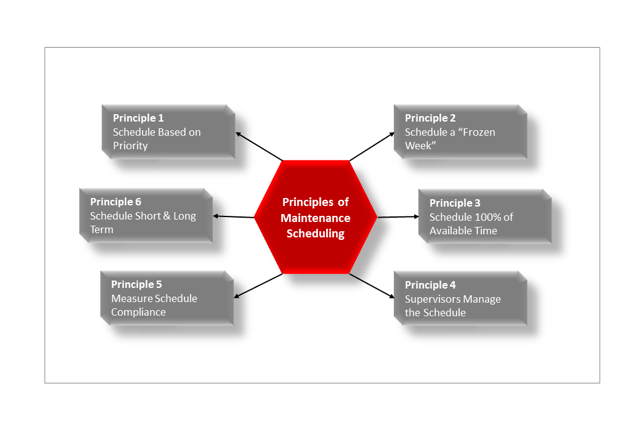
The six principles of maintenance scheduling are key elements to implement when tackling a maintenance “to do” list efficiently. So says Raymond Chizu, sales developer at WearCheck Zimbabwe.
‘The six principles cover prioritisation of tasks based on urgency, incorporating a frozen week, using available time effectively, supervisors actively managing the schedule, and measuring it for compliance, and the principles also allow for long- and short-term scheduling,’ he said.
‘Implementing maintenance planning and scheduling and executing the scheduled tasks with consistency and discipline from all the players, is a sure way to boost productivity in any plant.
‘Additionally, the heightened efficiency boosts team morale. The stable working environment has a positive effect on the amount of work that is completed. When the maintenance team witnesses the scheduled preventative maintenance tasks adding value to a given operation, it smooths the company’s journey along the road to reliability. Inefficiencies such as unplanned equipment failure are reduced, allowing the maintenance teams to work proactively, rather than reactively.
WearCheck’s Technical Bulletin 83 covers the topic in greater detail. You can read the full article here: https://www.wearcheck.co.za/shared/TB83.pdf
Published in
Blog
Tagged under
Friday, 13 January 2023 07:08
Dust contamination and component failure reveals a clear cause-and-effect correlation.

By Shesby Chabaya, HOD, WearCheck Zimbabwe Ops.
The road construction industry is naturally a high-dust environment that requires regular monitoring of all machine components to identify possible threats or risks before they negatively affect equipment.
Recently, the WearCheck team tested an oil sample from a client in the road construction industry. Below, are the details of the findings and lessons learnt with regards to the effects of dust contamination on machine health, as well as how these lessons can be utilised to re-model the oil sampling regime for greater success.
Laboratory findings at the 2,000 hour service were as follows: Iron 639ppm, Chromium 21ppm, Nickel 18ppm, Copper 147ppm, Lead 180ppm, Silicon 156ppm and particle quantifier reaching 12 995MgFe/L. The microscopic particle examination revealed the image below:
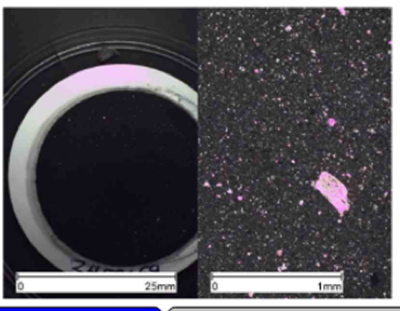 |
An interpretation of these findings pointed to evidence of a severe wear situation and a critical silicon (dust) level in the oil. The laboratory assigned critical severity status to the engine, and recommended immediate checking of the air intake system, among other checks. |
An interpretation of these findings pointed to evidence of a severe wear situation and a critical silicon (dust) level in the oil. The laboratory assigned critical severity status to the engine, and recommended immediate checking of the air intake system, among other checks.
Customer feedback revealed that the engine failed shortly after the service was done. The root cause of dust ingress was discovered to be a torn air induction hose. The tear was not easily visible with the naked eye, as it was located on the inner side of the air induction hose close to the engine block.
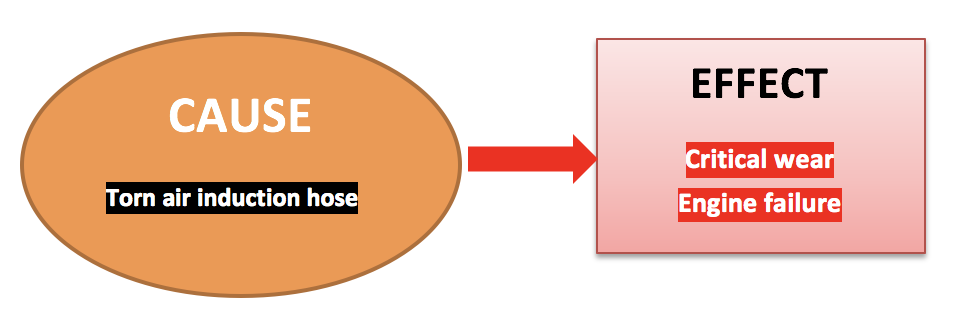
Evaluation - the tear on the air induction hose resulted in cement dust bypassing the air filtration system and being sucked directly into the engine, thus accelerating the rate of component wear. This scenario is that of correlation between a cause and effect as illustrated in the diagram below:
The road construction industry involves the application of cement during road construction, and any opening on the engine components will result in severe contamination, which poses a huge risk to component failure.
The torn air induction hose is the root cause of dust ingress, and the effect is severe wear (dust being the catalyst) and consequent engine failure. When an air induction pipe cracks after the air filter, dust enters the air intake manifold and finds its way into the engine. The dust mixes with lubricating oil and is carried through the engine via the lubrication system, acting like a “grinding paste” and wearing out components. The engine may fail to last longer than 300hrs depending on the intensity of dust ingress.
Unfortunately, this engine had not been sampled since the machine was commissioned. Only a single sample came through at 2,000hrs. Had the machine been sampled every 250hrs, the problem could possibly have been picked up earlier and rectified, avoiding a catastrophic failure.
A more regular and systematic oil sampling regime following set oil sampling intervals results in huge cost savings and increased equipment reliability. With a properly set up condition monitoring programme in place, specific parts can be ordered, and maintenance can be planned, thus avoiding interruption to business.
Published in
Blog
Tagged under
Thursday, 15 December 2022 07:43
The latest WearCheck’s Monitor newsletter offers valuable insights

Our latest issue of the Monitor newsletter is now live! In this bumper issue, we share knowledge about detergent additives and their essential role in keeping engines clean, and we share advice on dealing with varnish within oil. There is also information about our Lubrigard offering, with a focus on vacuum dehydration.
Added to all this, you’ll find some lovely feedback from our customer survey (thank you to all who participated!), and we are super proud to have South Africa’s very first CAT IV instructor in our Asset Reliability Care (ARC) division. There is also advice on determining drinking water quality, the 2023 oil analysis and Mobius training course dates, our festive season opening hours and lots more.
Published in
Blog
Tagged under
Monday, 14 November 2022 08:12
QUALITY COUNTS AT WEARCHECK

By Prinda Narasi, WearCheck’s quality administrator
November is World Quality Month – an annual celebration embraced by WearCheck with open arms, as it reinforces the team’s fundamental goal – the provision of world-class quality services.
At WearCheck, we take continuous quality improvement (CQI) very seriously. Our services are regularly audited by a range of agencies, including SANS (South African National Standards) and the SABS (South African Bureau of Standards).
WearCheck is currently the only company on the African continent that has earned multiple quality confirmation certificates, which include ISO 9001: 2015 and ISO 14001:2015 certification, and ISO/IEC 17025:2017 accreditation. These are audited regularly, and the company has never failed to have an accreditation or certification renewed.
Peace of mind
We are proud of our relentless dedication to top quality service – it gives our customers peace of mind, knowing that the laboratory results and analytics provided by WearCheck are scientifically accurate.
ISO 14001 recognises international standards implemented by companies to manage their environmental responsibilities, which is very important to WearCheck in line with the company’s earth-friendly work ethics. WearCheck was first awarded ISO 14001 certification in January 2005.
ISO 9001 was first awarded to WearCheck in 1996, and recognises the integrated design, development and provision of condition monitoring services to international standards.
ISO/IEC 17025 is the international standard that sets out the general requirements for the competent, impartial, and consistent operation of laboratories. WearCheck first earned this accreditation in 2012 for its laboratories, Laboratory and Set Point Water Laboratories, a division of WearCheck has also earned this certification.
Benefits for our customers
The ISO 9001:2015 standard is recognised worldwide. Some customers insist on only using certified companies because they know that management systems are constantly assessed and improved.
Further advantages include improved quality and service, delivery on time, right first time approach, minimised incidence of mistakes, improved reporting and communications, better quality products and services, more reliable production scheduling and delivery, and the fact that standards are maintained by annual assessments.
The ISO system promotes an efficient management process and is a mandatory prerequisite to tender for some public sector work. Coupled with the positive message that certification presents to both customers and staff, the system also reduces costs by highlighting time-saving procedures.
Published in
Blog
Tagged under